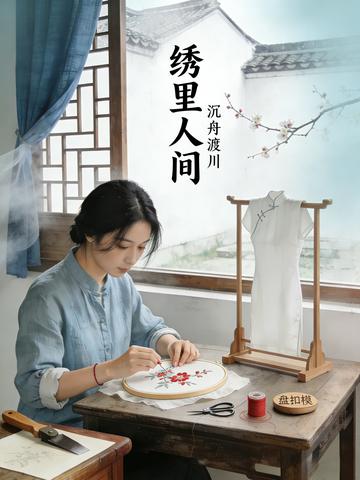
In the deep spring of 1985 in the south of the Yangtze River, seventeen-year-old Su Wan clutched the old scissors handed down from her grandmother and embroidered the first crooked plum blossom under the window. The needle holes on the fingertips contrasted with the blood drops on the cloth. In my ears I heard Aunt Li's gossip that "embroidery cannot be used as food", but in front of me was my grandmother's teaching of "the hands must be steady and the mind must be calm".
From the awkwardness of splitting sixteen strands of silk to the skill of rolling needles and hiding threads, from secretly going to the market to sell embroidered handkerchiefs in exchange for two pounds of meat, to customizing cheongsams for various beauties, Su Wan spent twenty years embroidering all aspects of life on the tip of the needle. She has seen a beautiful woman embroidering warm peonies to console her for a lifetime of wandering, a sad woman clinging to the broken lotus waiting to return home, and she has also watched Fa Xiaoyuan go to Shenzhen to pursue another way of life.
In the wave of the times, some people chase neon lights, but she guards the needlework basket; as the years go by, grandma passes away, Mrs. Shen passes down the white jade bracelet, and the silent carpenter Shen Mo always supports her silently in times of crisis. From a small rural courtyard to the "Late Embroidery Pavilion" in the town, from learning skills alone to accepting apprentices and teaching skills, her embroidery hides the mist of Jiangnan, the perseverance of the craftsmen, and the "needless to say" tacit understanding between the two craftsmen.
With a pair of old scissors and a strand of silk thread, Su Wan used stitch and thread to embroider the heritage of Su embroidery and embroider her own world.
Reader comments
Five-star review: The time embroidered stitch by stitch makes people feel warm and peaceful.
I read the first volume in one go and couldn't get back to my senses for a long time. This book is like the embroidery needle in Su Wan's hand. It penetrates into my heart steadily, needle by needle.
What impresses me most is the "slowness". It's not procrastination, it's the kind of down-to-earth, rooted growth. From when Su Wan pricked her finger with the first needle, to when she was able to embroider a crooked plum blossom, to when she sold embroidered handkerchiefs for the first time and earned enough money to buy two kilograms of meat, Su Wan wrote down every step in extremely detail. She was sitting by the stove, lighting a fire and embroidering at the same time. When the sparks splashed out, she used the tip of a needle to put them out, and the firelight reflected on her face - these scenes were like the stitches on embroidery, dense and dense, and the temperature could be seen.
My grandma taught me to "calm the mind and keep the hands steady". This is not a general principle, but it is really taught by holding hands, stitch by stitch. Later, when grandma got sick, Su Wan stayed by the bedside to embroider and let grandma take a closer look. My eyes were filled with tears as I read those chapters, but not a single tear was incited. It was just that heavy, unspeakable thing that stuck in my heart.
And those supporting characters. The mother kept saying "embroidering can be used as food", but secretly gave the peach cakes bought by her daughter to her grandmother; Aunt Li went from gossiping to saying "you are really good at embroidering" when borrowing salt; Xiaofang went to Shenzhen, and the three letters became thinner and thinner, and finally said "I won't come back in a few years" - everyone has their own path, and they all grow old or go far away in time.
The most amazing thing is the silence that barely speaks. Send embroidery frames, wood, and wooden molds, and leave every time you put down your things. Su Wan made him a coat, placed it at the door of the carpenter's shop and ran away. He put it on and stood at the door, the sun shining on the new coat. There is not a single line, but the scene can be remembered for a long time.
There is no golden finger in this book, there is no rebirth and counterattack, it is just a girl slowly embroidering her own path in a village in the 1980s by relying on stitches and threads. Prices have risen, so she has to buy two less skeins of thread; the cheongsam is broken, so she has to tear it apart and start over again; her grandmother is gone, so she sits under the tree and embroiders her first plum blossom.
While reading, I can smell the aged smell of camphor wood boxes, hear the crackle of firewood in the stove, and feel the astringency of silk threads passing through the cloth. The author writes about the days like embroidery, stitch by stitch, closely arranged. Looking back, it is already a complete picture.
Highly recommended to anyone who likes a slow pace, likes to watch craftsmanship, and likes to live slowly in words. After reading it, I want to pick up a needle, or I just want to calm down and do something well and slowly.
Waiting for the second volume. @ Shenzhouduchuan
A revelation about "feel"
The first volume of "Xiu Li Ren Jian" is a piece of slow art. It reminds us that in the rapid modernization process, there is a kind of time that flows at the speed of "splitting silk", and there is a kind of emotion that is transmitted with the precision of "a stitch presses a quarter of the previous stitch".
When Su Wan finished embroidering "Nine Plum Blossoms" in the last chapter (Chapter 60) and caught the falling petals and put it against her heart, what she completed was not only the inheritance of skills, but also the embodiment of female subjectivity - through the training of her "hands", she allowed her grandmother's "eyes" to be reborn in her body, allowing the "silk" of Jiangnan to continue its warmth in the changing times.
This is a novel that deserves to be touched and read. Its value lies not only in the story, but also in the text stitches that can be touched - dense, gentle, and with the warmth of life.
Thank you all, I hope you can give me more opinions.

Five-star review: The time embroidered stitch by stitch makes people feel warm and peaceful. I read the first volume in one go and couldn't get back to my senses for a long time. This book is like the embroidery needle in Su Wan's hand. It penetrates into my heart steadily, needle by needle. What impresses me most is the "slowness". It's not procrastination, it's the kind of down-to-earth, rooted growth. From when Su Wan pricked her finger with the first needle, to when she was able to embroider a crooked plum blossom, to when she sold embroidered handkerchiefs for the first time and earned enough money to buy two kilograms of meat, Su Wan wrote down every step in extremely detail. She was sitting by the stove, lighting a fire and embroidering at the same time. When the sparks splashed out, she used the tip of a needle to put them out, and the firelight reflected on her face - these scenes were like the stitches on embroidery, dense and dense, and the temperature could be seen. My grandma taught me to "calm the mind and keep the hands steady". This is not a general principle, but it is really taught by holding hands, stitch by stitch. Later, when grandma got sick, Su Wan stayed by the bedside to embroider and let grandma take a closer look. My eyes were filled with tears as I read those chapters, but not a single tear was incited. It was just that heavy, unspeakable thing that stuck in my heart. And those supporting characters. The mother kept saying "embroidering can be used as food", but secretly gave the peach cakes bought by her daughter to her grandmother; Aunt Li went from gossiping to saying "you are really good at embroidering" when borrowing salt; Xiaofang went to Shenzhen, and the three letters became thinner and thinner, and finally said "I won't come back in a few years" - everyone has their own path, and they all grow old or go far away in time. The most amazing thing is the silence that barely speaks. Send embroidery frames, wood, and wooden molds, and leave every time you put down your things. Su Wan made him a coat, placed it at the door of the carpenter's shop and ran away. He put it on and stood at the door, the sun shining on the new coat. There is not a single line, but the scene can be remembered for a long time. There is no golden finger in this book, there is no rebirth and counterattack, it is just a girl slowly embroidering her own path in a village in the 1980s by relying on stitches and threads. Prices have risen, so she has to buy two less skeins of thread; the cheongsam is broken, so she has to tear it apart and start over again; her grandmother is gone, so she sits under the tree and embroiders her first plum blossom. While reading, I can smell the aged smell of camphor wood boxes, hear the crackle of firewood in the stove, and feel the astringency of silk threads passing through the cloth. The author writes about the days like embroidery, stitch by stitch, closely arranged. Looking back, it is already a complete picture. Highly recommended to anyone who likes a slow pace, likes to watch craftsmanship, and likes to live slowly in words. After reading it, I want to pick up a needle, or I just want to calm down and do something well and slowly. Waiting for the second volume. @ Shenzhouduchuan A revelation about "feel" The first volume of "Xiu Li Ren Jian" is a piece of slow art. It reminds us that in the rapid modernization process, there is a kind of time that flows at the speed of "splitting silk", and there is a kind of emotion that is transmitted with the precision of "a stitch presses a quarter of the previous stitch". When Su Wan finished embroidering "Nine Plum Blossoms" in the last chapter (Chapter 60) and caught the falling petals and put it against her heart, what she completed was not only the inheritance of skills, but also the embodiment of female subjectivity - through the training of her "hands", she allowed her grandmother's "eyes" to be reborn in her body, allowing the "silk" of Jiangnan to continue its warmth in the changing times. This is a novel that deserves to be touched and read. Its value lies not only in the story, but also in the text stitches that can be touched - dense, gentle, and with the warmth of life.
Thank you all, I hope you can give me more opinions.