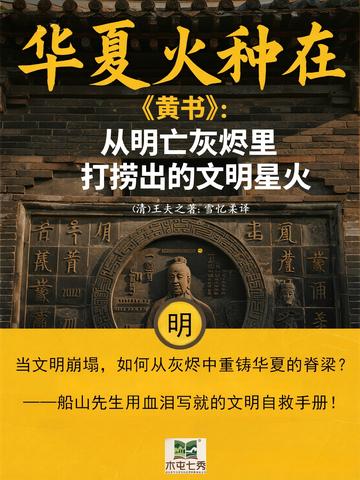
The Chinese Fire in "Yellow Book": the Spark of Civilization Salvaged from the Ashes of the Ming Dynasty
华夏火种在《黄书》:从明亡灰烬里打捞出的文明星火
- Status
- Completed
- Length
- 123k Words
- Updated
- 5mo ago
- Source
- Fanqie
Stats
Tags
Synopsis
Reader comments
In booklists 84
Explore more →

A Book Where You Can Learn Real Skills
Any book will do
High IQ, Machiavellian, Brain-Burning

Study Books
Are there any books that are helpful for studying? Please recommend! ! ! ! ! !

Books Suitable Only for Middle-Aged and Elderly People
I want to read a book similar to "Nine Points of Fool".
A Classic Chinese Cultivation Secret Book
Practice on a first come, first served basis
Literary Masterpiece, (ㆁωㆁ)

Metaphysics, Feng Shui, Bagua, Super Detailed and Easy-To-Understand Articles, All Informative
I want to read something similar to "Record of a Change of Destiny".
Magnificent! Summer! Have! God!

A Book That Will Make Your Brain Faster After Reading It

Full of Useful Information: All-Round Learning Book
Martial Arts Secrets, the Real Kind
Learning Books
If you are tired of reading romance, just read it to learn. Everything is OK. Focus on learning! ! !



My Bookshelf.

Recommendations for Several Novels That Can Be Called Classics
Brother, please give me a book
Now I Am so Broken That I Read the "Marrow Cleansing Sutra"...
Are there any particularly boring novels? Please, the child really can't sleep😫



Real Officialdom Novel
I want to read a book similar to "Romantic Career". Be real, don't be brainless


Life Skills, Useful Books
I would like to read a book similar to "Survival and Life Skills to Master for a Lifetime".
Conspiracy, Scheming, Intrigue, High IQ, Layout, Suspense
Tao, Buddha, Lord, Medicine, Xiangshu, Enlightenment, Change of Luck, Metaphysics, Self-Study
I would like to read a book similar to "Record of Destiny Change (Practical Techniques for Changing Destiny)". Take some time to feel it with your heart, you will have a different experience
Books That Can Be Used in Real Life
It's not the kind of storyline that just tells discussions, or the kind of writing that's very good, like Das Kapital

A Book That Can Transform You and Change Your Destiny
I want to read something similar to "Record of a Change of Destiny". Let's feel the non-deprecation that Teacher Dao Zhiguang has planted for each of us, find the meaning of life, and bravely pursue the seeds of dreams. A righteous mind, mindfulness, and altruism are the keys to changing lives and leading to happiness🔑Thanks to Dao Zhiguang, Mr.
Literary Masterpieces, Good-Looking Literary Novels
Like Literary Classics
I want to read a book similar to "La Traviata". I think this book is well written. I recommend it.
A Must Read to Change Yourself
I want to read something similar to "Record of a Change of Destiny". Easy to understand, very good
I am the translator Xue Yirou. When I met Wang Fuzhi in the pile of old papers, I knew that this was destined to be a conversation spanning three hundred years. Every word in "The Yellow Book" is soaked in the blood and tears of the survivors of the subjugated country. I use the "original translation" to restore his sonorous voice that "it can be Zen, it can be continued, it can be reformed, but it cannot be used to destroy barbarians." This was the final bottom line drawn by a scholar for Chinese civilization when the world collapsed. I use "interpretation" to analyze the profound meaning of his criticism of "the lonely Qin and the poor Song Dynasty": when the monarch regards the world as private property and "one person doubts the world", the country will not be a country. "Historical Mirror" is my selfish intention. I want these inspiring words to shine into people's lives today. In desperate circumstances, Wang Fuzhi still firmly believed that "China has enough wealth and military strength to strengthen itself." This cultural confidence has traveled through time and space and remains hot. I translated "Yellow Book" not for the sake of learning, but to rekindle the fire of national self-improvement in the hearts of every Chinese. This is my, a translator's answer to the sages, to civilization, and to this era.
Spiritual resistance in desperate situations: In the darkest moments of the Ming Dynasty and the Qing Dynasty, Mr. Chuanshan used his pen as a blade and wrote this "Civilized Self-Rescue Manual" in the cave of Shichuan Mountain. He refused to surrender to force, and used "the distinction between Chinese and foreigners" and "the ethics of clothing" to protect the roots of Chinese culture, and preserve the fire of civilization in despair. Institutional insights that penetrate history: Breaking away from moral judgments, we point out that the bureaucracy of the Ming Dynasty where "everyone is suspicious of each other" is the root cause of the country's destruction. We put forward the dialectical thinking of "dividing and combining as the rhythm of civilization", which enlightens us: real governance does not rely on suspicion and prevention, but to design a system that allows trust and vitality to coexist. Echoes of thought across the ages: From Tan Sitong's praise of "a thunder in the south of the mountains" to today's readers' resonance with national confidence and civilization's survival, Chuanshan's thought is like a deep well from which every era can draw strength - it tells us that the revival of civilization has never relied on isolation, but on anchoring tradition in change and keeping oneself in openness.
After reading this book, I couldn't calm down for a long time. The words Wang Fuzhi shouted three hundred years ago, "We cannot let foreigners take over our country," still ring true after all these years. It turns out that our national spirit has been preserved through generations. Closing the book, I felt my spine straighten a little.
No matter how sophisticated the system is, if it loses its trust internally first, it will be an empty talk to defend against powerful enemies externally and keep the people at peace internally. The phrase "If you can't even protect your own civilized ethnic group, what's the point of talking about benevolence and righteousness?" In the book makes the relationship between the right to survival and moral ideals very clear. Looking back at history, we can see how many prosperous times breed corruption in the midst of peace and prosperity, and are eventually torn apart by "invisible separation"; how many troubled times give birth to new "unions" due to common crises. This made me realize that true wisdom does not lie in predicting storms, but in making the foundation solid and absorbing changes with systems and beliefs instead of fearing them.
After reading this book, I realized that the national integrity in our bones does not come from thin air. People nowadays always talk about having cultural self-confidence. If you read this book, you will know that three hundred years ago, there were people who believed more firmly than us that China can strengthen itself. I really recommend everyone to read it. It will let you re-understand what "everyone is responsible for the rise and fall of the world."
Reading this book made my eyes well up several times. The words written by Wang Fuzhi three hundred years ago can still penetrate my heart even after a long time. The translator's interpretation was also very attentive, allowing me to understand the heavy feelings of home and country. After closing the book, I couldn't calm down for a long time, as if I finally understood what "everyone is responsible for the rise and fall of the world."
After reading this book, I couldn't calm down for a long time, and suddenly I understood what the bottom line is. Three hundred years have passed, but Mr. Funayama's words are still hot. It turns out that the stubbornness in our bones has long been written clearly with blood and tears. The moment I closed the book, I suddenly felt that the land under my feet was really worth guarding for a lifetime.
The most powerful thinker on the face of the earth, given the pain of subjugating his country and the world, he came up with a guide that is both despairing and full of hope. Faced with the pain of national subjugation and genocide at that time, Wang Fuzhi used his profound thoughts and broad historical vision to summarize the five thousand years of Chinese civilization history, and put the three hundred years of Ming Dynasty's actions into the five thousand years of history for examination and analysis. The conclusions he reached are amazing. Wang Fuzhi knew that his ideas would not be successful in the Qing Dynasty. Before his death, he asked his son to keep them in his mind, and declared that in two hundred years, they would be great in the world. Now his prediction has come true!