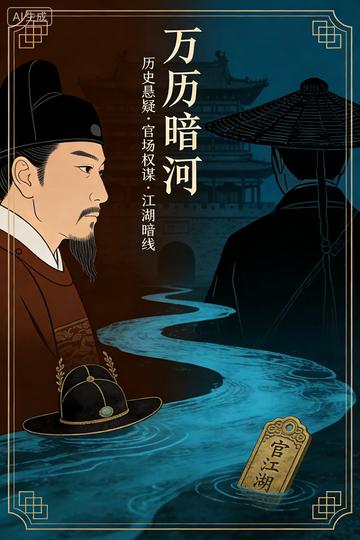
In the last years of Wanli, three corpses floated up in the Jiangnan Canal, all with the same "double knot" in their throats. Lu Chenzhou, a failed scholar, picked up a "secret ledger" sealed with oil and wax under the bridge. The ledger contained mineral tax increases, salt quotation seals, external treasury filling gaps, and Liao pay gaps. Each entry pointed to the same truth: the money that was supposed to go to the border was swallowed up by layers of "orders" and finally became the lives of the people and soldiers.
As soon as the secret account was revealed, the Lu family silk shop was closed down, and his father was forced to press the handprint of "self-confidence"; Huqiu Deng Market was turned into a corpse collection bureau, and the inner court seal, fake wax seal and "blank list" surfaced: The blank space of the list can write anyone to death, and the "scabbard" behind it holds the master model and format, which can batch forge documents, change confessions, and change charges, making murder as legal as a stamp.
Lu Chenzhou was forced to go with Zhao Xingzhou, the royal guard, and Shen Tingxue, who was carrying the secret of the Cinnabar Line: they fled from the south of the Yangtze River to Donglin Academy, broke into the Gongyuan of the capital and the imperial prison, and sought survival among the Qing Dynasty, factory guards and the inner court. Every time they made a reversal or reversed the case, someone would change the wording for them; every time they traced a gap, someone would light the fire first. When the Liaodong war was defeated, frontier wages were cut off, and the capital's supplies were exhausted, Lu Chenzhou finally understood: the country's demise was not only due to military defeat, but also to victory due to "form" - paper is harder than people, and seals are bigger than the sky. In order to survive and save the truth, he could only reverse the murder pattern into evidence.