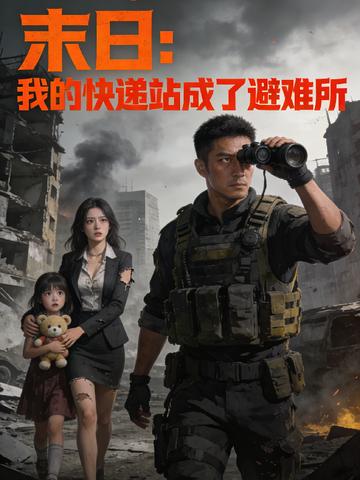
A sudden virus drags the world into an abyss, and the city becomes a zombie-infested ruin. The protagonist Lu Zheng, a retired scout with a promising future, is now just a courier stationmaster seeking stability. When the apocalypse broke out, he relied on his extraordinary military literacy and extreme familiarity with the urban terrain to transform his express station into a solid fortress. While searching for supplies, he rescued the trapped beautiful teacher Su Qing and her daughter. This unexpected "delivery" became his heaviest responsibility in the last days. On the road to survival, the three-person team not only has to face endless zombies, but also faces people's hearts that are more terrifying than zombies. From thugs fighting for resources to a refuge warlord establishing a twisted order, Lu Zheng fought bloody battles and gradually transformed from a tough guy who just wanted to live alone to a guardian and leader. He and Su Qing developed a love that transcended life and death in their adversity, and he also established a bond with Su Qing's daughter that was better than family ties. In the end, they no longer looked for shelter, but created a new home full of hope with their own hands.
Reader comments
In this picture of survival in the apocalypse, the deepest paradox has emerged: the fragments of civilization are precisely the weapons of survival. The thin steel wire, the utility knife, and the identity tag with peeling paint are all the remains of the collapse of order, but they are used to fight against the more primitive chaos. Humanity hangs by a thin thread—both the weapon of strangulation and the rope of salvation. When the protagonist puts on the enemy's skin and uses violence to restrain violence, we can't help but ask: In the wilderness where bestiality is rampant, is it possible to protect the spark of literature in our hearts that refuses to be extinguished only by using the guise of fighting fire with fire?
In the wind of doomsday, there is never a true lone traveler.
Lu Zheng's express delivery station was originally a safe haven for him to escape the past, but after the virus outbreak, it became a beacon of protection for others. The moment he rescued Su Qing's mother and daughter, his cold desire for survival finally seeped into the warmth. He would fight with the villain for a piece of bread, teach the little girl how to read in the middle of the night, and learn to believe in "tomorrow" again under Su Qing's eyes.
What's more terrifying than the snarling zombies is the desolation of people's hearts; what's more precious than a solid fortress is the bond of clinging to each other. When they are no longer "survivors" but "builders", they understand: the real home is never reinforced concrete, but there are people waiting for you to return, and there are people who will go into the wilderness with you. This is a post-apocalyptic survival record, and it is also a gentle elegy for "protection" and "love".
A sudden virus drags the world into an abyss, and the city becomes a zombie-infested ruin. The protagonist Lu Zheng, a retired scout with a promising future, is now just a courier stationmaster seeking stability. When the apocalypse broke out, he relied on his extraordinary military literacy and extreme familiarity with the urban terrain to transform his express station into a solid fortress. While searching for supplies, he rescued the trapped beautiful teacher Su Qing and her daughter. This unexpected "delivery" became his heaviest responsibility in the last days. On the road to survival, the three-person team not only has to face endless zombies, but also faces people's hearts that are more terrifying than zombies. From thugs fighting for resources to a refuge warlord establishing a twisted order, Lu Zheng fought bloody battles and gradually transformed from a tough guy who just wanted to live alone to a guardian and leader. He and Su Qing developed a love that transcended life and death in their adversity, and he also established a bond with Su Qing's daughter that was better than family ties. In the end, they no longer looked for shelter, but created a new home full of hope with their own hands.
If the character � appears in it, it is because the platform has determined that it is sensitive text, so I can only cover it up. I really don't want to change it.
Atop the ruins, a brightly lit express station became the coordinates of despair. The novel uses fireworks to fight against the coldness of the apocalypse. Materials and people are protected together. Ordinary jobs bloom with a sense of security, warmth and superiority in the disaster. Super pretty!
The overall quality is very high, and the knowledge points/stories are all in place. It is a good book.
In this picture of survival in the apocalypse, the deepest paradox has emerged: the fragments of civilization are precisely the weapons of survival. The thin steel wire, the utility knife, and the identity tag with peeling paint are all the remains of the collapse of order, but they are used to fight against the more primitive chaos. Humanity hangs by a thin thread—both the weapon of strangulation and the rope of salvation. When the protagonist puts on the enemy's skin and uses violence to restrain violence, we can't help but ask: In the wilderness where bestiality is rampant, is it possible to protect the spark of literature in our hearts that refuses to be extinguished only by using the guise of fighting fire with fire?
In the wind of doomsday, there is never a true lone traveler. Lu Zheng's express delivery station was originally a safe haven for him to escape the past, but after the virus outbreak, it became a beacon of protection for others. The moment he rescued Su Qing's mother and daughter, his cold desire for survival finally seeped into the warmth. He would fight with the villain for a piece of bread, teach the little girl how to read in the middle of the night, and learn to believe in "tomorrow" again under Su Qing's eyes. What's more terrifying than the snarling zombies is the desolation of people's hearts; what's more precious than a solid fortress is the bond of clinging to each other. When they are no longer "survivors" but "builders", they understand: the real home is never reinforced concrete, but there are people waiting for you to return, and there are people who will go into the wilderness with you. This is a post-apocalyptic survival record, and it is also a gentle elegy for "protection" and "love".
A sudden virus drags the world into an abyss, and the city becomes a zombie-infested ruin. The protagonist Lu Zheng, a retired scout with a promising future, is now just a courier stationmaster seeking stability. When the apocalypse broke out, he relied on his extraordinary military literacy and extreme familiarity with the urban terrain to transform his express station into a solid fortress. While searching for supplies, he rescued the trapped beautiful teacher Su Qing and her daughter. This unexpected "delivery" became his heaviest responsibility in the last days. On the road to survival, the three-person team not only has to face endless zombies, but also faces people's hearts that are more terrifying than zombies. From thugs fighting for resources to a refuge warlord establishing a twisted order, Lu Zheng fought bloody battles and gradually transformed from a tough guy who just wanted to live alone to a guardian and leader. He and Su Qing developed a love that transcended life and death in their adversity, and he also established a bond with Su Qing's daughter that was better than family ties. In the end, they no longer looked for shelter, but created a new home full of hope with their own hands. If the character � appears in it, it is because the platform has determined that it is sensitive text, so I can only cover it up. I really don't want to change it.
Atop the ruins, a brightly lit express station became the coordinates of despair. The novel uses fireworks to fight against the coldness of the apocalypse. Materials and people are protected together. Ordinary jobs bloom with a sense of security, warmth and superiority in the disaster. Super pretty!
The overall quality is very high, and the knowledge points/stories are all in place. It is a good book.
The ups and downs of the story are so exciting