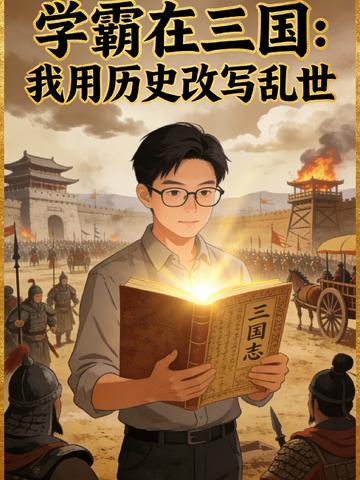
Under the city wall of Jizhou in the seventh year of Jianning, Lin Che, a graduate student in the Department of History, opened her eyes from the blood stains. The broken "Martial Classics General Essentials" in her arms was oozing blood. This is the late Eastern Han Dynasty with no system and no golden fingers - only the 739 volumes of history in his mind and the collapsing world.
The first thing he did was to use trigonometric functions to calibrate the trebuchet range and bury the "Yuan" flag at the boundary bridge thirty years in advance.
The second thing was to put half a piece of wheat cake in the bowl of the wandering boy Ge Yi and said: "Learn "Nine Chapters of Arithmetic" from me, Kong Ming."
The third thing is to hold the secret report sent by Diao Chan. The ink is still wet and reads: "There is a change in Wancheng, and Dian Wei will die."
When he unfurled the big flag embroidered with the Chinese character "Han" at the top of Xuchang City, the archaeological team on the other side of the Yangtze River was prying open his coffin. There are no jade garments or gold threads in the main tomb chamber, only mountains of bamboo slips:
"Records of Stirrup Forging (First Year of Chuping)"
"Distribution Map of Kerosene Reserves (used in the 13th year of Jian'an)"
"Discussing Three-part Return to Han Shu with Cao Mengde"
On the last piece of wood, there is the woman Qingjun's handwriting:
"History is not a river, it is a text that we can modify. - Cicada, in the spring of the 24th year of Jian'an"