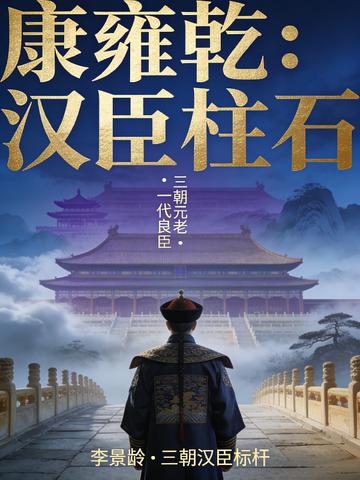
Li Jingling, who holds two master's degrees in Qing history, woke up to find that his soul had traveled back to the first year of the Kangxi reign. He had become the fifth son of Li Shualtai, Viceroy of Fujian and Zhejiang and a member of a prominent Han Chinese military family in Liaodong in the early Qing dynasty.
Born into the elite Plain Blue Banner, he knew all too well the deep divide between Manchus and Han Chinese in the early Qing, the bloodshed of the Revolt of the Three Feudatories, and the dangers of the struggle among the nine princes for the throne. He also knew that, despite his family's apparent splendor, it would begin to decline after his father's death, be swept up in political turmoil, and ultimately fall into obscurity.
Fortunately, he had a photographic memory, along with three centuries of knowledge about Qing history.
At seven, he swept through three rounds of exams and won first place in the entry-level examination. At ten, he passed the provincial exam. At thirteen, he ranked third in the palace exam and entered the Hanlin Academy. After his service as a junior compiler ended, he was appointed education commissioner of Fujian. Three years later, he returned and topped the Hanlin Academy's major examination, earning an exceptional five-rank promotion to the Southern Study and becoming the Han official Kangxi trusted most.
Throughout his life, he held fast to his principles: he never formed factions, pursued private gain, took bribes, or indulged in women. He served only the court and cared deeply for the people.
As the struggle among the nine princes for the throne raged, he remained neutral and unshakable. When Yongzheng's reforms met fierce resistance, he coordinated affairs from the center and held the line. When Qianlong's extravagance began to grow, he spoke frankly to remonstrate with him and protect the foundations of the state.
Kangxi arranged his marriage, and he and his wife stood by each other through thick and thin, devoted to one another for life. He took no concubines or secondary wives, becoming a rare and celebrated example among the great families of the capital.
Serving through the reigns of Kangxi, Yongzheng, and Qianlong, he resolved every regret left by his family and the dynasty. In the end, he became a pillar among Han officials, received the posthumous title Wenzheng, and was enshrined in the Temple of Worthies. He lived a life that began and ended honorably, and his name would be remembered for generations.