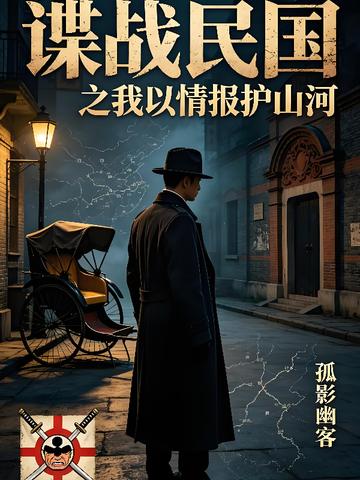
My name is Cheng Du.
I was Director Cheng of the Guangming District Public Security Bureau in Jingzhou City, Handong Province, in In the Name of the People. After being convicted and imprisoned, I was stabbed to death with a toothbrush in the prison bathhouse by a crime boss I'd personally dealt with years earlier.
When I opened my eyes again, it was 1933, in Republican-era China, and I was a low-ranking police officer.
He turned Japanese nobles into informants at the Special Higher Police, planted operatives in the 76th Department, and built an intelligence network that kept him abreast of the enemy's every move.
Dai Chunfeng said, “With Cheng Du on our side, the Military Statistics Bureau never loses. If we had a hundred men like him...”
Jiang Shenkai said, “With him around, not even the Japanese emperor has any secrets from me.”
Tsuchihara Kenji said, “As long as he lives, every plan of the Empire is nothing but wastepaper.”
Kagesa Masaharu said, “I fear no army of thousands. The only one I fear is Cheng Du.”
Yu Zecheng said, “Following Director Cheng is so easy. All I have to do is sit back and win.”
Zhao Lichun said, “Handong's development depends on you, Cheng. My son, Zhao Ruilong, is too mischievous. Keep him by your side to pour tea and run errands.”
The women who came into contact with him said he was mysterious and deadly.
The year after victory, he “died” in an explosion on the Huangpu River. The real him was in Hong Kong, sipping tea and planning investments in Coca-Cola and Middle Eastern oil.
Many years later, someone asked him, “What did you spend your life striving for?”
Watching the sunset over Victoria Harbour, he said softly, “Li Dakang, Zhao Donglai, Sun Liancheng, you three, get over here and pay attention. In my past life, I was thrown straight into a high-level game. I really couldn't give orders there. But in the Republic of China, in the Military Statistics Bureau, I ask you: can I give orders now? Stand at attention and sing me a battle hymn of loyalty.”