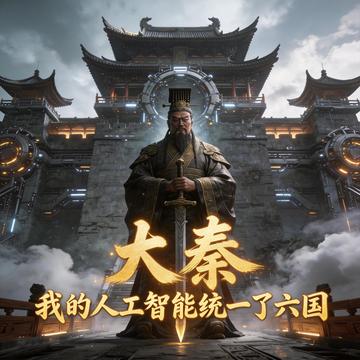
Lin Mu, a senior AI product manager at a major tech company, was the undisputed king of overwork.
He woke to find himself kneeling at an execution ground in Xianyang, with a blade at his neck. The “Heavenly Net System” in his mind told him: “Survival probability: 7.3%. Recommendation: start bluffing immediately.”
So he made a prediction before the crowd: “At noon in three days, a torrential rain will fall on Xianyang.”
Three days later, rain poured down in sheets.
From then on, the Qin court had a new “sorcerer.”
When Ying Zheng asked how to govern the country, he said, “Your Majesty, first we need to build a data center.”
When Li Si asked how to manage the people, he said, “How about a little KPI evaluation?”
When Zhao Gao tried to win him over, he responded by sending him a guide to “Avoiding Workplace Gaslighting.”
He worked with the Mohists to build an ancient computer, used big data to put down rebellions in the six states, applied supply chain management to build imperial roads, and used public-opinion monitoring to predict twenty years in advance that Xiang Yu and Liu Bang would cause trouble.
As Ying Zheng lay dying, he clutched Lin Mu's hand. “The best decision I ever made was not having your head chopped off.”
And when everyone thought he was about to dominate the court, he quietly carved out a stone chamber at the foot of Mount Li and engraved the knowledge in the Heavenly Net onto stone tablets:
“If China faces disaster in a later age, open this chamber.”
He transmigrated across a hundred years and lived through nine dynasties, becoming a legend.
The last thing the Heavenly Net said before going dormant was:
“Host, thank you for letting me witness how one person can change a civilization.”