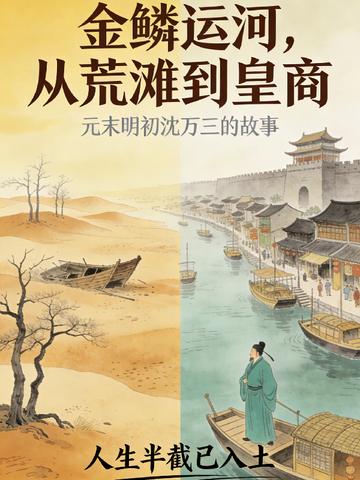
During the Zhizheng era of the Yuan dynasty, the realm stood on the brink of chaos. Emergency physician Shen Zhongrong awoke from a dream to find himself ten-year-old Shen Wansan. Before his eyes lay the barren banks of Zhouzhuang, a hundred starving corpses, and a debt of sixty taels. Others transmigrated into princes, nobles, and generals. From the start, all he had was a muddy, silt-choked wasteland by a disused river.
Drawing on his modern knowledge of medicine, economics, and navigation, Shen Zhongrong healed the people under the name "Disciple of Bian Que" and improved agriculture with the mulberry-dyke fishpond method. With a business vision far ahead of its time, he set his sights on the empire's lifeline: the Grand Canal linking Beijing and Hangzhou. Starting with retrofitting grain ships and smuggling goods, he went on to control salt certificates and open up maritime trade. Along the canal, he wove a vast commercial network, maneuvering among the Yuan court, rebel armies, and merchant guilds.
By the time Zhu Yuanzhang declared himself emperor in Nanjing, Shen Zhongrong had become the richest man south of the Yangtze. He advised on building city walls and clearing the waterways for grain transport, and even used his own fortune to reward the imperial troops when the northern frontier was threatened. But as the saying goes, "A man is not guilty, yet his jade makes him a target." His wealth, enough to rival the empire's, aroused the imperial family's suspicions. An imperial decree exiling him to Yunnan sought to crush this commercial legend on the Tea Horse Road.
But this time, Shen Zhongrong refused to accept his fate. Traveling across the southwest, he befriended local chieftains and opened up the Tea Horse Road, expanding his business into Annam and Burma. At last, he returned to Nanjing with unprecedented achievements and immense overseas profits. Not only was he pardoned for his supposed crimes, he was also granted the hand of Princess Ningguo, becoming the Ming dynasty's one and only imperial merchant consort.
In his later years, he retired at the height of his success and returned to live in seclusion in Zhouzhuang. He wrote The New Grain Transport Methods and Illustrated Gazetteer of the Maritime Kingdoms, then quietly entrusted his commercial empire to his disciples and clan, securing the Shen family's fortune for generations. He left behind a legend: "Even a man in plain robes can stand proud before princes, and even merchants can protect the realm."






This book is so well written, the writing subject matter is novel, the writing angle is refreshing, the storyline is reasonable and attractive, and the description of the characters and emotions is delicate and profound. It is well worth reading!!!
This is the first time I have seen such a novel subject. I only knew about Shen Wansan before, but there was no novel about his rise and growth. After reading it for so long, the author should have a certain degree of historical research when writing it. It is not a void construct, and it is different from the cool articles in the market. It is worth reading. It describes the poignancy of a person at the bottom of that turbulent era. In order to make a fortune, he seized every opportunity and tried his best to make a fortune. This led to the creation of the legendary Shen Wansan. I hope to write the history thoroughly. Good luck to the author.
The story has a tight rhythm and no stagnation. Shen Wansan's growth conforms to the logic of history. It is adapted from history but does not deviate from history. Shen Wansan circulates between Zhu Yuanzhang, Zhang Shicheng and Yuan Ting, and gradually grows stronger. It starts in the late Yuan Dynasty and becomes stronger in the early Ming Dynasty. The story will eventually change Shen Wansan's ending. Welcome everyone to continue to pay attention to this story.
The subject matter is novel and very attractive, the plot is compact and not procrastinating, and the characters are vivid and distinctive. It is a rare and good novel.
This kind of subject matter is really a test of one's basic skills, politics, economy and culture, the author's writing style is delicate, the plot is compact, and there is no delay.