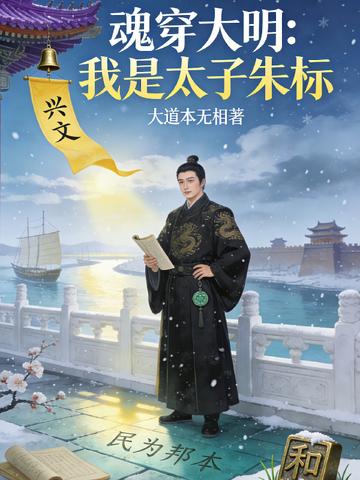
When the modern soul enters the East Palace, the trajectory of history is quietly deflected in Zhu Biao's hands.
He used benevolence as his blade and wisdom as his armor, and under the afterglow of Hongwu's iron fist, he embarked on a very different imperial path. Save the meritorious officials, secure the vassal king, open the canal to benefit the people's livelihood, expand the maritime territory to connect the four seas, promote culture and education to educate the people, and benefit the people's livelihood to consolidate the foundation.
In thirty-seven years of being an emperor, he did not use weapons, but he made the barbarians subservient; he did not practice cruel methods, but he made the world clear. In the court, there is Hai Rui's uprightness and Xie Jin's talent; in the rivers and lakes, there is the peace and happiness of the people and the prosperity of business travel. From the East Palace to the Yangxin Hall, from Nanjing to the West, he weaved an invisible net with generosity and benevolence, protecting all the people in the country.
When the snow fell on the palace wall, he looked at the flowing clouds and sighed "enough". In these two words, there is hidden the most perfect ending of an emperor - not the legend of the golden war and the iron horse, but the ordinaryness of the smoke curling from the kitchen stove; not the thrilling and cunning intrigues, but the stability of the old being taken care of and the young being educated.
This is a rewritten history of the Ming Dynasty, a hymn belonging to Emperor Xingwen. Here, there is no bloody battle of Jingnan, only the shadow of sails on the canal, the sound of books in the academy, the waves of rice in the farmland, and the most solid foundation of a dynasty: the people's will, the country will be forever solid.