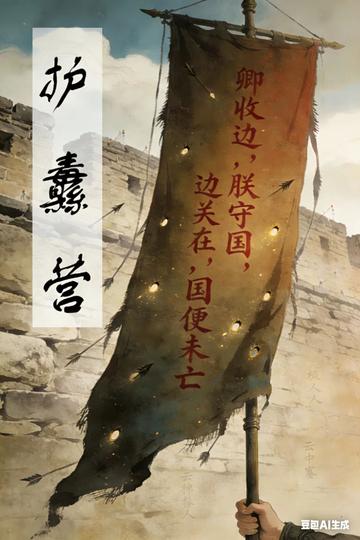
In the 61st year of the founding of the Daliang Dynasty, Emperor Wu devoted his entire life to attacking the Xiongnu from the north, regaining the Hetao, and building the Yunzhong Fortress. Three days before his death, he summoned the guard general Han Zhao at night and gave him a secret decree: "You will guard the border and I will guard the country. If you return to the court, the border pass will be lost; if the border pass is lost, all my battles in this life will be in vain. After my death, no matter who in the court calls you or by what name you are summoned, you will not be ordered to lead the army."
Three days later, Emperor Wu died. In the autumn of the same year, kings competed for the throne and the capital was in chaos. For the next twenty-three years, there was a melee in the Central Plains, and the imperial court no longer existed.
However, Yunzhongsai never withdrew a single soldier or took a step back.
Han Zhao guarded the pass for eleven years and died in office. There were three successors - flag bearer Zhou Zhuang, border student Chen Mo, and flag guard Zhao Yuan - none of whom took charge of the army. What they protect is the broken flag of Emperor Wu's blood-written edict; what they protect is the border gate that has long been forgotten by the Central Plains.
The law of protecting the banner is not a military law or a national law, but an agreement between the dead and the living: those who die while protecting the banner will have their souls in the flag; people cannot retreat from the flag, and they must die in front of the flag. The heavier the flag is, the more names it carries; the flag has spirit because the living are unwilling to forget it.
Ninety-seven years later, the flag was burned down in a fire at the Imperial Ancestral Temple, and the remaining flags wandered among the people, with no known end.
But on the ruins of Yunzhong Old City, people tie white cloths every year. Wherever the wind blows, hunting is like a flag. The person tying the cloth cannot tell who it is tied to. He only knows that it must be tied, but he only knows that it must not be broken.
It was a book that had not been enshrined for three hundred years.
It was a camp named after the blood of four generations.
Those are the loyal bones that have never been extinct in the history books of the Central Plains and have not been buried in the wind and snow at the border.