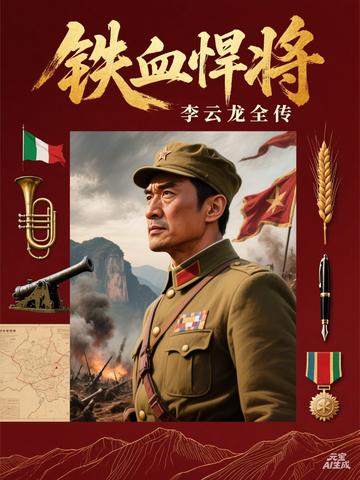
The bloody battle: from the blast of the Bantian Regiment with a single cannon at Cangyun Ridge, to the roar of the "Italian artillery" in Ping'an County; from the glory of capturing the Japanese Regiment flag to the life-and-death contest in the defense of the arsenal. During the eight years of the Anti-Japanese War, Li Yunlong won every iron-blooded victory and engraved the "Sword Spirit" on the Taihang Mountains.
Brotherly love: from mutual dislike to Zhao Gang to sharing life and death, forming the "Iron Triangle" in northwest Shanxi with Ding Wei and Kong Jie, and fighting wits and courage with brigade commander Chen Geng but also sympathetic to each other. Behind the battlefield is a comradeship that is thicker than blood.
Fighting in all directions: in the War of Liberation, he led his troops to fight from the Central Plains to Hainan; to resist U. S. Aggression and aid Korea, he fought a bloody battle with the U. S. Army at -40 degrees below zero in Changjin Lake; in peacetime, he was awarded the title of general, but his heart was always focused on the battlefield; war broke out again in southern Xinjiang, and he resolutely returned to the front line in his sixties.
Feelings of family and country: His newlywed wife died in Pingan County, and he turned his grief into anger to kill the enemy; his son inherited his father's ambition and died on the battlefield in southern Xinjiang. He said with tears, "He is worthy of being my son, Li Yunlong." From the Taihang Mountains to Kinmen Island, from the Yalu River to the Laoshan front line, he devoted his life to the liberation and defense of this country.
Final destination: In the winter of 1984, a generation of generals fell. In accordance with his last wish, his ashes were buried in three places: the Cangyunling battlefield, witnessing his first emergence; the old site of Ping'an County, remembering the love of his life; and the highest point of Kinmen Island, looking at his unfinished dream of reunification.
This is not the story of one person, but a collective portrait of a generation of Chinese soldiers. From the Agrarian Revolution to reform and opening up, from millet to rifles to the modern army, Li Yunlong and his comrades wrote the history of the Chinese nation's war of resistance, liberation and army building with their blood and lives.