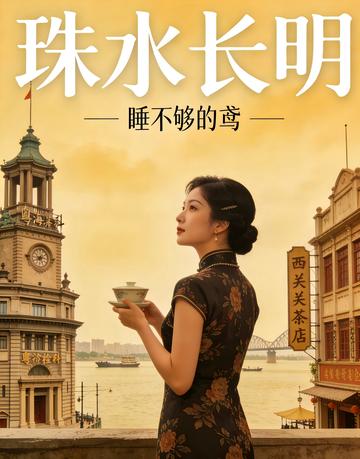
In 1919, the waters of the Pearl River at White Swan Pond mingled fresh and salt, and the return of one woman would stir the tea smoke and turbulent currents across all of Lingnan.
Lin Shuying, a modern woman newly returned from the London School of Economics, carried on her shoulders the century-long fortunes of her family’s old tea house in Xiguan. By day, she was the first female commissioner in the tea inspection division of the Guangdong Maritime Customs, using scales and test tubes to fight a bloodless “tea war” in the clock tower of the Shamian concession. By night, she was the young proprietress of Shuying Pavilion by Lychee Bay, seeking the lost ancient technique of “night tossing Dan Cong tea” behind its lattice doors.
This was a revival that began with a teacup.
From the ancient Meiguan Trail to the waterways of the Xijiang, from the clouds over Chaoshan’s tea mountains to the waves of Lingding Ocean, she followed the tea trails of her ancestors, searching for mother trees on cliffs and building a tea guild among the people. What she wanted to revive was more than a business. It was the Lingnan landscape steeped in every cup, the brilliance of its artisans, and the roots of its culture.
This was a vigil kindled amid the flames of war.
When she met Chen Qiming, a comprador for a foreign trading firm on the surface but a patriot devoted to “saving the nation through industry” beneath, love and ideals intertwined in the fragrance of tea. They sailed on tea boats and sent messages in tea bricks, bringing their personal skills into the tide of national salvation amid the shimmering Pearl River and the calls of the Northern Expedition. From tea gatherings in Xiguan mansions to moonlit nights at the Whampoa Military Academy, the deepest expression of love was this: “May the things we protect together live to see the dawn.”