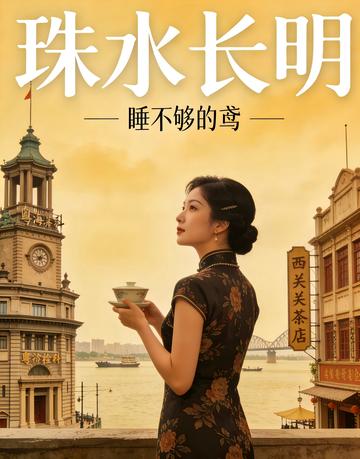
In 1919, the salty and fresh water of Baietan River converged. The return of a woman would stir up the tea smoke and storms in Lingnan.
Lin Shuying, a new woman who returned from the London School of Economics and Political Science, is burdened with the century-old rise and fall of the Xiguan Old Tea House. During the day, she was the first female commissioner of the Tea Inspection Section of the Guangdong Customs. In the bell tower of the Shamian Concession, she used scales and test tubes to fight a smokeless "tea war"; at night, she was the young head of the "Shuying Pavilion" on the shores of Lychee Bay. Behind the gate, she pursued the lost ancient method of "a single bush of tea shakes green at night".
It's a renaissance that started in a teacup.
From the Meiguan Ancient Road to the Xijiang Ship Channel, from the clouds and mists in the Chaoshan Tea Mountains to the waves of the Lingding Ocean, she followed the tea traces of her ancestors, looking for mother trees on the cliffs and forming tea gangs in the markets. What she wants to revive is not just a business, but also the mountains and rivers of Lingnan, the stars of craftsmen and the cultural roots soaked in the tea.
This is a watch that burns with flames of war.
When she meets Chen Qiming, who appears to be a comprador from a foreign company but is actually a lofty ideal of "saving the country through industry," love and ideals are intertwined in the fragrance of tea. They used tea boats as boats and tea cakes as faith. Between the waves of the Pearl River and the clarion call of the Northern Expedition, they merged their personal skills into the torrent of national self-help. From the tea banquet at Xiguan House to the moonlight at Whampoa Military Academy, the deepest affection is "Let the things you and I protect see the morning light of tomorrow."