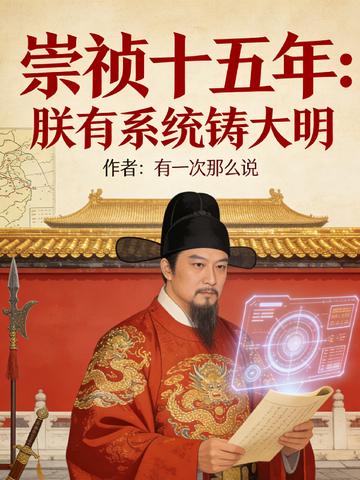
The work is based on the crisis in the fifteen years of Chongzhen, and accurately anchors the historical nodes of the Ming Dynasty's internal and external troubles: the tragic defeat of Songjin destroyed the last elite, the rebellion shook the foundation, the Qing soldiers went south to knock on the pass, and the dynasty's collapse was imminent. A modern ordinary person, Wang Qi, travels through a portable upgradeable system and is deeply bound to the desperate Emperor Chongzhen to build a mission reward and punishment mechanism with imperial power as the core. When Chongzhen completes the mission, Wang Qi delivers modern equipment from small firearms to tanks, drones and even aircraft carriers, forming an army, navy and air force, and owning the equipment rights. This prevents the loss of military power from the source. The setting is novel and logically consistent.
The narrative focuses on time travel and system, connecting the plots and war lines: with the help of modern cognition and systems, Chongzhen promoted internal affairs reforms, eradicated corruption, reconstructed the administrative system, and consolidated the foundation; then he sent his troops north to defeat the Qing troops, stabilize the border, cross eastward to resist Japan, punish the Japanese invaders, and incorporate the former Japanese territory into the territory. The plot progresses layer by layer, with dense points and strategic depth, highlighting the feelings of family and country.
The work relies on historical reality and reconstructs the destiny of the Ming Dynasty through the perspective of a time traveler. It not only satisfies the sense of military exhilaration, but also uses innovation and battle to show dynastic redemption and personal growth, conveying the core of peace and tolerance, and has both readability and ideological value.
Reader comments
I really like this kind of historical article
Write at speed
I really like this kind of historical article Write at speed