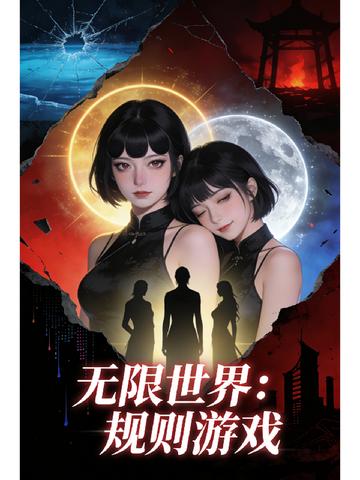
When Chen Fengqi opens her eyes, she finds herself lying in a dilapidated ancient village. Beside her, her younger sister Chen Yekong comments in her usual lazy tone, “Doesn't this opening feel like that cheesy infinite-flow web series you insisted on watching last week?”
They have been caught up in an incomprehensible experiment conducted by a higher civilization: ten beginner villages, each with one hundred players, who enter three regions at random through the gates outside their villages: ancient East, medieval West, and a modern world with four genders. The rules of each region have been taken to extremes: filial piety makes you willingly lie beneath a sheet of ice, divine authority forces you to name a “witch” and send her to her death, and capitalism never lets you stop.
They meet the cool-headed Mu Ling, the silent Wu Qi, and the mysterious Mo Li. The abilities of the five women, devouring, creation, mind control, weapon mastery, and psychic resonance, gradually awaken over the course of ten instances. But the truly terrifying thing has never been the monsters. It's the rules packaged as “the natural order”: the Twenty-Four Filial Exemplars are real, witch trials are real, and entrenched class divisions are real.
When they clear every instance and return to the original beginner village, the AI running the simulated world announces that the experiment is over and the world is about to be destroyed.
Chen Fengqi looks at the ice lake, the church, and the office tower they passed on their journey, and at all the players who struggled, laughed, and died. She softly asks her sister, “Can we stop it from disappearing?”
Chen Yekong sighs. “I knew you'd say that.”
That day, the Sun God and the Moon Goddess are born.

The description is detailed, the structure is clear, and the sense of substitution is strong