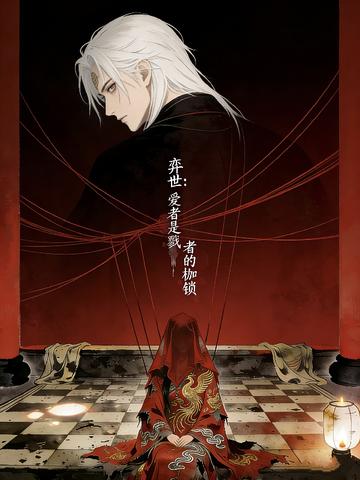
A Game of Life and Death: Love Is the Killer’s Chain
弈世:爱者是戮者的枷锁
- Status
- Ongoing
- Length
- 355k Words
- Genre
- Eastern Fantasy
- Subgenre
- Fantasy High-Concept
- Updated
- 5mo ago
- Source
- Fanqie
Synopsis
More by this author
In booklists 16


Let's Review Each Other's New Books! I'll Definitely Return the Favor!
I want to read something similar to There's No One More Cautious, Only Someone Even More Cautious.


New Novel, Let’s Review Each Other
Looking for books similar to "The Mysterious Finger Technique".

Mutual Reviews Guaranteed, Five-Star Book Reviews
Looking for books similar to Baby, My Mission Is to Love You for a Lifetime. Everyone's welcome. Authors with little traffic, come here for mutual reviews and support. Post one and I'll review it.


Tomato Newcomers Starting New Stories, Follow and Review Each Other, and I'll Return the Favor
Looking for books similar to "Thirteen Weeks to Doomsday". Are there any new authors like me, beginners with no readers? Come share your work. We can review, follow, and encourage each other. After you've reviewed mine, message me and let me know. I'll definitely return the favor ❛˓◞˂̵✧

New Books, Let’s Swap Reviews and Likes! Come Take a Look!
I'm looking for books like "The Ascension Tower: The Tale of Clouds and Smoke".

New Books, Let’s Review Each Other

Let’s Exchange Five-Star Reviews for Our New Books
I want to read something similar to Yin-Yang Tribulation: Seeking the Way. New author here. Come in for mutual reviews and five-star ratings, fair for everyone.


Let's Help Each Other Out with Our New Books! I'll Review Yours Too
Looking for books similar to "A Sprig of Spring in Bloom". Historical romance preferred. Let’s all review each other’s books!!! I’ll reply within three hours of your comment
Let's Read and Review Each Other's New Books! Come Chat! (All Genres)
Looking for fresh blood!!


I Need Lots of High-Quality Reviews in Return!
Looking for stories like There's No One More Cautious, Only Someone Even More Cautious.

I'm a New Writer. How About We Review Each Other's Books?
Looking for books like "Dream in Another World".


❤️New Author Looking for Support! Follow for Follow, Review for Review❤️
Looking for something like Sensory Disorder. Many hands make light work, so let's help new authors support one another!

New Books for Mutual Reviews
Looking for books similar to "The Eastern Palace's Heart Keeps Changing". I'm new here, and I always reply to comments.


Let's Review Each Other! Let's Review Each Other! Let's Review Each Other!
I'm looking for stories like "There's No One More Cautious, Only Someone Even More Cautious".


New Book, Come Say Hi! Let’s Review, Follow, and Like Each Other. I’ll Always Return the Favor Within 24 Hours!
Looking for books like Asking the Dao of Reincarnation. Any new authors want to exchange reviews or follow each other?
New Book Swap and Reviews
Looking for books similar to "Phantom Eighteen Needles of Medicine King Valley". New-book review swap: reply if you’re interested. Listen for at least 30 minutes, add it to your bookshelf, and leave a five-star review.
Reader comments 68
Translated by Google Translate
This is an infinitely popular masterpiece with two male protagonists with a grand setting and strong emotions. The protagonist spends 300 million years playing endless chess games, killing gods and betraying fate for the sake of his remaining soul, even allowing civilization to be buried with him. The novel takes the "crazy criticism aesthetics" to the extreme. In thousands of reincarnations and retrospections, he resists fate in an extreme way, burning his body with karma and drowning his reason in a sea of blood. The most touching thing is the sentence "If time does not allow her to exist, I will tear apart time." This is not only a declaration of war against fate, but also the ultimate protection. The group portraits of all the members are crazy and intertwined with philosophical speculation. It is a masterpiece of redemption that is full of devastation but extremely gentle.
This is a fantasy-themed novel with a unique concept that makes readers' imaginations expand and they can't stop. The novel begins with a lot of suspense. The male protagonist comes from a long way away. As soon as his left foot steps on the rough mud, a girl's soft voice rings in his ears, asking him if he can solve a question. The boy just responded vaguely... The author has profound literary skills, fluent and beautiful language, especially the exquisite and wonderful descriptions. It is worth reading and recommending, and giving five-star praise!
The protagonist Mo is not a perfect god, but a light chaser who has been driven crazy by 300 million years. Even though he knew that what he was protecting was just a phantom, he still used the universe as a chess piece and time as a blade, just to take his family home. The setting of more than 20 million reincarnations is mind-blowing. The Yuanxu chess game at the beginning is full of a sense of fate. There is no redundant foreshadowing, and there is foreshadowing hidden in every dialogue. It breaks away from the stereotyped routine of cool novels and writes "obsession" into the flesh and blood of the universe. The pleasure and abuse are intertwined to the extreme, and the stamina is so great that you can't get out of it for a long time after watching it. Highly recommended to readers who like depth and structure!
What shocked me most was not the grandeur of walking alone for 300 million years or crushing thousands of worlds, but that it pushed the concept of "obsession" to the height of philosophical speculation. The protagonist's madness is not for simple resurrection, but the ultimate questioning of "existence" itself. When love becomes a shackle, when memories turn into homework, every time he rewrites the rules, he is making a gamble with nothingness that is destined to fail. The "sadness" of this book does not lie in the parting of life and death, but in the tragedy of knowing that it is an phantom, but still trying to embrace it with all your strength. It breaks out of the framework of the traditional cool novel and uses extreme madness to compose a requiem dedicated to all those who want nothing. Highly recommended to readers who like depth and structure. It's beautiful. The author's writing is profound and the more you read, the better it becomes.
As a bookworm who has been pursuing fantasy for more than ten years, "Yi Shi: Jingwei Fills the Sea and I Fill Time" is definitely a treasure that I have recently discovered. It breaks away from the stereotype of cool writing and writes the word "obsession" into the bones and blood of the universe. The protagonist Mo is not a perfect god, but a light chaser who has been turned into a crazy person by 300 million years of time. He knows that what he is guarding is just a phantom stitched together by cause and effect, but he still uses the universe as a chess piece and time as a blade to smash fate just to take his family home. The characterization is truly heartbreaking. The setting of more than 20 million reincarnations is mind-blowing. The Yuanxu chess game at the beginning is full of a sense of fate. There is no redundant foreshadowing, and there is foreshadowing hidden in every dialogue. It elevates personal affection to the cosmic pattern, and is both passionate and sadistic. It is a good work that long-time bookworms can catch up on in one go.
I was hooked from the introduction of "Walking Alone for Three Hundred Million Years", and I was not disappointed after reading it! The structure is as complete as a precision gear, and the succession and transition are seamless, and the infinite reincarnation setting is played out: every retracement is not a simple repetition, but a progressive recovery of foreshadowing. The narrative rhythm is relaxed and relaxed. When it is tense, it is like a drumbeat, and when it is soothing, it leaves enough room for emotional fermentation. The reader's emotions are completely controlled by the author. "Crazy criticism aesthetics" is not only a character label, but also a weapon against fate - the logic is so rigorous that even the madness of "killing gods and rebelling against fate" seems reasonable. This skill of "writing absurdity as inevitable" is so worth pursuing!
It's unsystematic and not a cool piece of writing, but it's this slow pace and philosophical thinking that makes people immersed. "I'm here to take you home" - this sentence is the only reason for walking alone for 300 million years. The pattern is grand and the emotion is deep. It is suitable to calm down and read slowly. Each character has his own obsession and return. The relationships between the characters are complex and intertwined, making the book very layered to read. If you calm down and read it, you will be surprised.
There are indeed some problems in the early stage of "Yi Shi: This Heart's Fiery Sun Will Not Extinguish Until Death" Disadvantages: The suspense atmosphere is relatively full at the beginning, but the male protagonist appears late. The perspective in the first fifty chapters is mostly from the female protagonist's side. The pace is slow, the foreshadowing is a bit lengthy, and there are too many foreshadowings. After a hundred chapters of group portraits and settings were rolled out, the overall story slowly entered its state, and the male protagonist's obsession, reincarnation, and chess game gradually became clear. The overall writing style is depressing, and it is a work that needs to be read calmly and slowly. It is not eye-catching in the early stage and gradually gets better in the later stage. Advantages: The integration of philosophical thinking into the story can better resonate with the vividness of each character and make us reflect on what the author wants to express behind each chapter. The theme setting of this work is very good. There are only figures who are soberly pushing the boulder up the mountain. Together, they constitute a contemporary group portrait of Sisyphus. Camus wrote in "The Myth of Sisyphus": "The struggle to reach the top is enough to enrich the human soul." This book gives a crueler and gentler answer: When you know that there is nothing on the top of the mountain, and when you know that the boulder is destined to roll down, will you still choose to push? The characters know that certain efforts are doomed to be in vain, just like the protagonist's 300 million-year search, which may end up just "sixty years of confirmation every day that this is not her." But what the author wants to ask is exactly this: If the result is doomed to nothingness, is the process itself still worth it? It has all the hallmarks of a utopia: perfect emotional support, precise psychological intervention, standardized growth trajectories. But as is the fate of all utopias, the flip side of perfection is the suffocation of control. The author does not simply criticize this system. On the contrary, he demonstrated the "gentle tyranny" of the system: it gives you warm bread and established scripts; it heals your trauma and deletes your "abnormalities". This complexity allows the novel to go beyond a simple "dystopian" narrative and enter a deeper realm: we long to be cared for, but fear the conditions behind care; we long for order, but hate the price of order. The most philosophically impactful setting in the novel is when the characters begin to doubt the authenticity of the system, and doubt itself becomes a test item for the system. This is an accurate metaphor for the contemporary state of existence: we question consumerism, question success studies, and question mainstream values, but even the behavior of "questioning" may have been incorporated into a tool for system self-renewal. The way out provided by the novel is to stay awake in the system, improvise in the script, and still choose to take the pain and warmth in front of you seriously even though you know it may be in vain. Revaluation of Utopian Socialism and Idealism: Is Persistence a Disease or a Medicine? The protagonist has traveled for 300 million years, playing countless chess games just to resurrect a few phantoms. From a utilitarian perspective, this is the ultimate waste. For one person, countless worlds are sacrificed. But the author does not simply judge. He shows the duality of this persistence: it is both a disease and a medicine; it is both a flame of destruction and an eternal light. This makes us rethink the definition of "idealism." In an era of pragmatism, any pursuit beyond personal interests may be ridiculed as "utopian." But the novel raises questions through the tragedy of the protagonist: If "reality" means accepting that a loved one is gone forever, and admitting that some scars cannot be healed, then is "fantasy" a more honest attitude towards survival? Perhaps the answer lies in the author's writing. Continuing to read [Working on manuscript][Working on manuscript][Working on manuscript]
The title and introduction of "Yi Shi: The Lover Is the Shackles of the Lover" both reveal a strong aesthetic of crazy criticism. The protagonist, Mo, crushes 300 million years of civilization and buries hundreds of millions of civilizations for a single remnant soul. This extreme obsession is both shocking and tragic. The title of "Love is a shackle" is completely heartbreaking in "The Boundless Sea of Suffering" and "The Phantom of Cause and Effect" - it turns out that the forced resurrection is just self-deception. The writing style is sharp and full of sadism, suitable for readers who like deep obsession and fatal tragedy.
Walking alone for 300 million years just for the sake of returning home, Mo's crazy and affectionate comments directly brought tears to the eyes, the stamina is too great. The writing is full of explosive golden sentences, and each sentence carries a sense of fateful fragmentation and igniting power to the extreme. The intertwining of pleasure and abuse is so extreme that he can overturn the entire universe, but he can't keep the person he wants to marry. With the obsession quantified by billions of reincarnations, he vividly wrote "Love to the extreme is crazy". The grand narrative with the universe as a chessboard is wrapped in the most extreme tenderness and paranoia, and the more you watch, the more you watch.