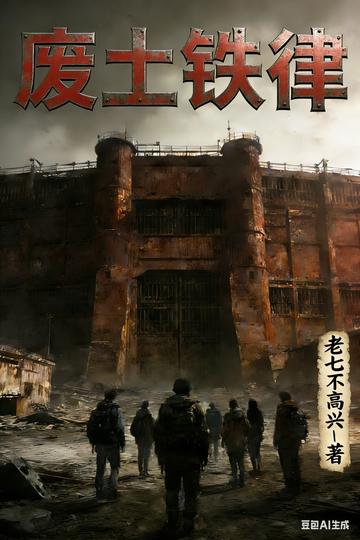
Ten years after the nuclear war, Lin Feng led five survivors to discover an abandoned prison. There's water, there's land, there's a wall - they don't run away anymore.
But when there are more people, trouble comes. Lin Feng solved it in the simplest way: setting rules. "The iron law has no mercy. Those who abide by the rules will live, and those who break the rules will die." From six people to tens of thousands, from prison to country - the birth of the Huaxia Kingdom.
This is the first "Iron Law of the Wasteland": to survive, you need order.
After the founding of the People's Republic of China, the problem deepened. When the body is preserved, why is the soul tied to it? Civilization took root again on the ruins. But the peace was short-lived. Along the eastern coast, Japanese pirates massacred villages, and "Liberate the Continent" written in blood brought the eighty-year national feud before our eyes again. Three thousand elite soldiers marched across the sea, fought a bloody battle in Okinawa, and landed in Kyushu. War criminals were put on public trial, and the Japanese island was set up as a penal colony for Chinese felons.
This is the second part of "Regaining Chinese Civilization": Only when you understand why you live, you deserve to live.
The news spread around the world. A force calling itself the "Human Civilization Revival Society" is integrating half of the world, claiming that "humanity must be unified." China proposes a "community with a shared future for mankind": not who devours the other, but each retains its own civilization and faces the end of the world together.
This is the third "Community of a Shared Future for Mankind": When a person is strong enough, where is the boundary of his responsibility?
This is not a heroic legend, but the choice of a group of ordinary people. They were afraid of death and pain, but they chose to stay, obey the rules, fight, and sacrifice. Because they know that if one person cannot survive, a group of people can survive; if civilization continues, the dead will not be considered in vain. In the wasteland, order is the bone, civilization is the soul, and the world is the responsibility.
Reader comments
After reading part of it, I feel pretty good. The author's character dialogues are brief and effective. This can be regarded as a characteristic. Although the character description is simple, it is basically enough. The plot is okay (the feeling that our village is prosperous). But I haven't seen the background and reasons of the doomsday in detail yet, and the protagonist is a driver (seems to be) and he knows so much)
At first I thought it was a doomsday theme, but I didn't expect it to have a bigger picture behind it! Full of style [Thinking]
After reading part of it, I feel pretty good. The author's character dialogues are brief and effective. This can be regarded as a characteristic. Although the character description is simple, it is basically enough. The plot is okay (the feeling that our village is prosperous). But I haven't seen the background and reasons of the doomsday in detail yet, and the protagonist is a driver (seems to be) and he knows so much)
At first I thought it was a doomsday theme, but I didn't expect it to have a bigger picture behind it! Full of style [Thinking]