Three Hundred Years of the Rise and Fall of the Great Song: A Thousand-Year Wager Between Splendor and Fragility
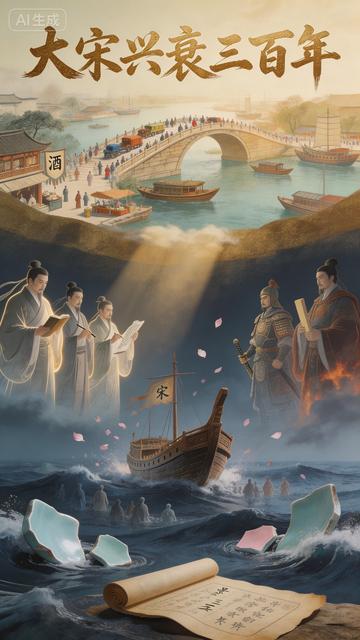
In 960, Zhao Kuangyin was proclaimed emperor at Chenqiao Station, beginning the three-hundred-year legend of the Great Song. This was an age of unrivaled prosperity, captured in Along the River During the Qingming Festival; of names that illuminated the history books, including Su Shi, Wang Anshi, Yue Fei, and Sima Qian; and of a civilization that led the world for a thousand years, with a GDP accounting for 60 percent of the global total. Its armies wielded fire lances and thunder-crash bombs, and its fleet was the most powerful in the world.
But why did none of this become an unbreakable empire?
Using the style of a novel to revisit history and the perspective of a historian to pierce the mysteries of success and failure, this book takes you through the political ingenuity of the cup-of-wine disarmament, the humiliation and calculations behind the Chanyuan Alliance, and the age-old injustice of Yue Fei's death at Fengbo Pavilion, all the way to the final scene of one hundred thousand soldiers and civilians at Yashan plunging into the sea rather than surrendering.
With time as its thread and events as its weave, this book brings history vividly to life while probing the deeper logic of institutions and human nature. It is a stirring elegy for a dynasty that inspires both love and loathing.


It follows history, has a complete structure, detailed historical facts, clear context, multi-dimensional narration, and a combination of narrative and commentary. After reading it, people will have a clear understanding of the history of the rise and fall of the Song Dynasty. This is a good book worth reading and listening to again and again.