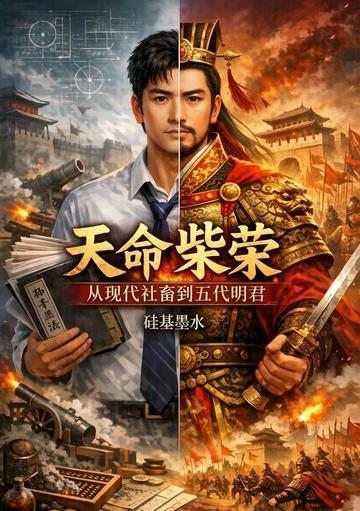
When Li Zhe, a modern social beast, died suddenly in the pile of historical materials, when he opened his eyes again, he turned out to be Chai Rong, Shizong of the Later Zhou Dynasty, who was dying on the bed - this king who should have died of illness in the middle of the Northern Expedition in history, leaving behind the regret of "died before he left the army".
It is now June 959 AD. The Northern Expeditionary Army is stagnant. The Sixteenth Prefecture of Yanyun is out of reach, and the powerful minister Zhao Kuangyin is eyeing him. In addition to the remaining memories of the original owner, Li Zhe also has modern knowledge that spans thousands of years.
From pretending to be sick repeatedly to gain time, to using "Sun Tzu's Art of War" combined with management to rectify the imperial army; from implementing accounting systems and issuing "treasury bonds" to raise military expenses, to establishing the "Tiangong Institute" to improve steelmaking techniques; from using meteorological knowledge to ambush the Khitan coalition forces of the Han Dynasty, to using psychology to disrupt political opponents and persuade enemy countries to surrender - the "reborn" Chai Rong used modern thinking to reshape troubled times.
But the road to change was startling at every step: scholar-bureaucrats fiercely opposed the New Deal, veterans questioned the emperor's sudden change in temperament, and the Khitan cavalry were still eyeing the north. What's even more frightening is that Li Zhe found that his memory and that of the original owner Chai Rong were slowly merging. The fifth-generation Mingjun who worked hard to rule seemed to have never really left...
When the Simplified Chinese Enlightenment Movement encountered a thousand-year context, when gunpowder first roared on the Youzhou city wall, when "Xian De Tong Bao" began to unify the broken currency system - how far can a time traveler go with modern knowledge? In the end, who sat on the Taishan Fengchan platform and read out the proclamation for worshiping the sky, was it historical researcher Li Zhe or Chai Rong, Shizong of the later Zhou Dynasty?