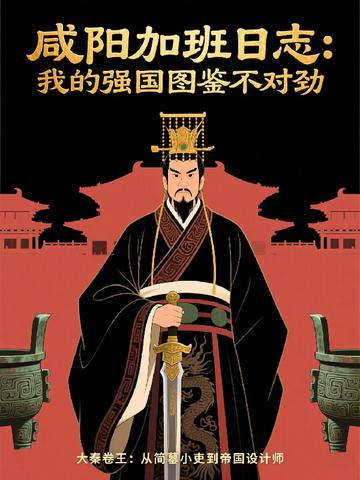
Jiang Shubai, an archivist, dies suddenly while working on a project to digitize ancient texts. When he opens his eyes again, he has become Lu Qi, the son of a bamboo-slip craftsman in Xianyang, Qin. Bound to the [Strong Nation Compendium System], he soon discovers that his golden finger has limits: he can only advance history through “enlightenment,” while directly revealing the future earns him a punishment that blurs his memories.
Starting with a three-part contract form in the Southern Market, he improves documents and standardizes measurements. He catches the eye of Neishi Teng and enters the logistical heart of the campaigns to destroy Han and conquer Zhao. The System’s missions press him at every turn: lay the foundations for unification within five years and unlock four compendium branches covering agriculture, military supplies, governance, and public trust.
He standardizes crossbows, designs a commandery-and-county structure, and promotes legal reform, but repeatedly faces warnings at pivotal moments in history: saving Qin Shi Huang accelerates the burning of books, while improving weapons fuels further conquest. System rewards and moral costs pull him in opposite directions, as modern ideas collide with Qin’s iron laws.
When Qin Shi Huang makes his fifth eastern tour, the System presents its ultimate choice: [30 days until the upheaval at Shaqiu. Intervene?] Jiang Shubai hides the Governance Strategies for Qin, compiled over his lifetime, in the academy’s underground vault and chooses to let history run its course.
Qin falls and Han rises. Two thousand years later, an archaeological team opens a bronze box. Inside, neat seal script reads: “Use data to govern; let standards benefit the people.” The archivist who worked himself to death during an overtime shift had planted a seed of progress beyond his age, in the most Qin-like way imaginable.