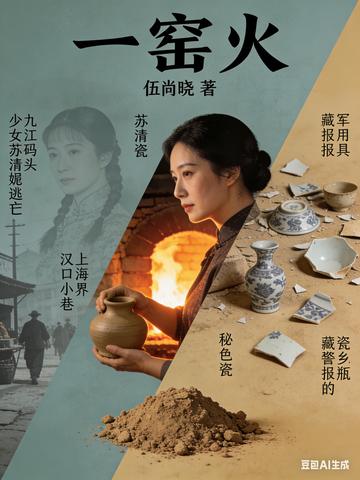
In the first year of the Republic of China, 16-year-old Su Qingci lost everything overnight - her father died in a kiln fire, her stepmother identified her as the murderer, and she was forced to flee her hometown of Jingdezhen.
On the way to escape, she unexpectedly learned a shocking secret: her mother had not died long ago as her father said, but was imprisoned in a Shanghai manor by British businessman Fisher and forced to bake secret-color porcelain that had been lost for thousands of years. What makes her even more frightened is that the man who sneaked into the house at night, the secret letter, and the sentence "three days later" - her stepmother colluded with outsiders for the half-secret color formula passed down from her family.
From the Jiujiang dock to the alleys of Hankou, from Fisher's manor to the Shanghai Concession, from the war-torn troubled times to the dawn of New China, Su Qingci spent sixty years doing only one thing: firing porcelain.
She has burned bowls for the common people to eat, porcelain bottles with hidden information, military tableware for the Japanese, and secret colors that she doesn't even know where they have gone. She has met people who love her, people who hate her, people who lie to her, and people who help her. She lost her mother, father, stepmother, sister, and best friends. In the end, she only had a kiln, a pair of hands, and a handful of soil grabbed from the ruins of her hometown.
"Fire in a Kiln" is set in the Jingdezhen porcelain family and tells the story of an ordinary porcelain worker's daughter who spent her whole life guarding a craft in the tide of the times. The fire in the kiln has not been extinguished for sixty years. It is a testimony to a woman's resilience that has grown out of suffering, and it is also the last persistence of an ancient craft in troubled times.
Reader comments
I have read more than 60 chapters in one go in the past few days. The opening chapter of "Midnight Movement" and "Fire in a Porcelain Kiln" caught my attention. The author is good at psychological description, and the description of the environment is also to highlight the psychological activities of the characters... I have observed that the author especially likes to use parallelism, and I prefer this kind of writing rhythm.
I have read more than 60 chapters in one go in the past few days. The opening chapter of "Midnight Movement" and "Fire in a Porcelain Kiln" caught my attention. The author is good at psychological description, and the description of the environment is also to highlight the psychological activities of the characters... I have observed that the author especially likes to use parallelism, and I prefer this kind of writing rhythm.