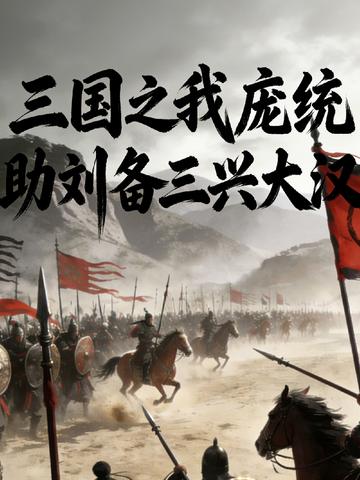
It is said that with either Wolong or Fengchu, one can bring peace to the realm. Perhaps Heaven favored Liu Bei, for he gathered both Wolong and Fengchu under his command. Yet during the Battle of Luo City, Pang Tong, who had marched with the army, was unexpectedly struck by a stray arrow and killed. Liu Bei had lost a vital arm.
If Pang Tong had not died, and Zhuge Liang had not needed to enter Shu ahead of schedule, could the fate of Shu Han have changed?
Read on to see how Fengchu Pang Shiyuan, after a dream brought on by a night of heavy drinking, unexpectedly witnessed the history that would unfold over the following centuries: the White-Clad Crossing of the River, Guan Yu's death, the Battle of Yiling, Zhuge Liang's death at Wuzhang Plains, Jiang Wei's nine northern campaigns, Deng Ai's secret crossing of Yinping, Sima's takeover of Wei, the Rebellion of the Eight Princes, the upheaval of the Five Barbarians, and more.
Each scene felt as though he had lived through it himself, and became etched in his memory. Can a very different Pang Tong change history and help Liu Bei achieve the great dream of restoring the Han dynasty for a third time?
In 210 AD, Liu Bei claimed to be me and Sun Quan claimed to be the King of Wu. At this time, Cao Cao was not even the Duke of Wei. He was completely destroyed. There was a group war. Liu Bei's 80,000 men faced off against Cao Cao's 100,000 men. He annihilated 20,000 enemies and captured 8,000 people. He did not suffer any losses at all. Cao Cao was written too stupidly, and there were some language errors such as his triumphant return. I concluded that the author is not suitable for writing this type of novel 🤦