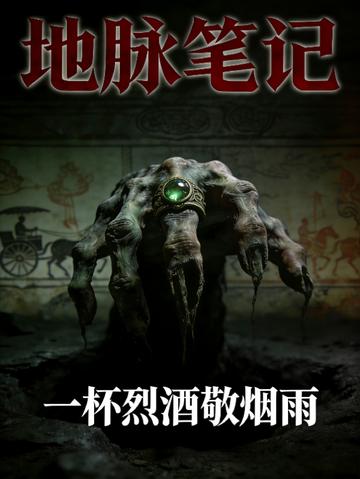
In 1934, Chen Qingshan, a geology student, received a keepsake his father had sent before disappearing: a bloodstained map of a mining region in the northwest.
To uncover the truth, he was forced to join the Nationalist government's Northwest Geological Survey Team. But he had no idea that everyone on the team had their own agenda. The shrewd antique dealer Zhao Tiezhu had been ordered by a warlord to search for the former Qing dynasty's Dragon Vein treasure. The taciturn guide Shen Mo bore a mysterious mark, a totem passed down through generations of guardians of the earth's veins. And the Japanese geological consultant traveling with them carried a secret document from the Kwantung Army's special service unit at his waist.
Beneath an abandoned coal mine, the team found no mineral deposits, but a pit full of corpses from Japanese biological experiments and a bronze key covered in ancient seal script. When team members began dying one after another under bizarre circumstances, Chen Qingshan pieced together the truth from the coded journal his father had left behind: the so-called “Dragon Veins” were actually three geological energy pathways running across China, and the key was the only means of activating a device left behind by a prehistoric civilization to control them.
The various factions dropped their disguises at the Yinshan altar, where gunfire rang out alongside the ancient mechanisms. Shamanic murals revealed that if the Japanese gained control of the earth's veins, geological data from across East Asia would become a weapon of invasion. At the brink of life and death, Chen Qingshan had to choose between setting off the device and dying with everyone else, or allowing the nation's lifeline to be stolen.
The only record he left behind was half a page: “March 17, rain. We have decided to let the secret remain buried forever. If you find this notebook, remember: some things should belong to no one.”
On the final page of the notebook, someone had faintly added a line in pencil: “They didn't die. I saw a photograph of three people in the archives of the Lanzhou Geological Bureau in 1956.”