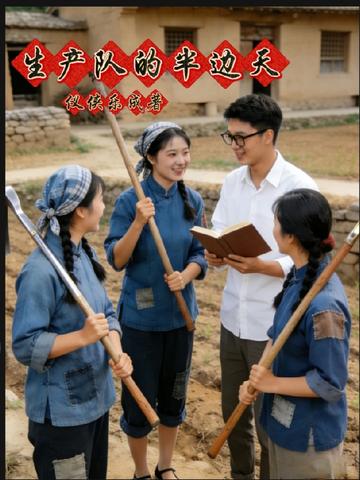
Introduction to the novel
In rural Shandong in 1963, Lin Hongying was the most eye-catching figure on the field ridge of the Xiangyang production team. She is top-notch in transplanting rice, cutting wheat, raising fields, and carrying burdens. She is vigorous and hard-working, and is recognized as a model worker in the team. She is affectionately called "women hold half the sky" by the villagers. In the same year, Chen Shuwen, an educated youth from the city, came to the production team with his belongings on his back. As a weak scholar, he lacked physical strength and was unfamiliar with farm work. He often failed to keep up with the group's progress. He was ridiculed in public by the outspoken and aggressive Lin Hongying, but he still refused to admit defeat and worked hard day and night to practice his skills.
A sudden severe drought swept through the village. On the battlefield of drought relief, Chen Shuwen tried his best to hold on to the fields, but finally fainted on the ridge of the field due to overwork. Regardless of exhaustion, Lin Hongying carried him on her back and rushed several miles of mountain roads to the hospital. At the moment of life and death, sincere feelings quietly emerged between the two of them. Since then, they have worked side by side, planning water canals, leading members of the commune to work intensively, and relying on each other on the loess soil.
Storms came suddenly, and the turmoil of the special era broke the calm. Chen Shuwen was suspended from labor and criticized due to family background issues. In the most difficult years, Lin Hongying endured huge pressure and shouldered the production burden of the production team alone, guarding food and people's hearts. She also took risks to secretly send food and warmth to Chen Shuwen, and protected her lover with the simplest perseverance.
After the clouds cleared, Chen Shuwen was finally vindicated, and the two held the simplest but warmest wedding in the witness of all members. They took root in the Xiangyang production team, worked at sunrise and rested at sunset, accompanied by simple food and food, walked through wind, frost, rain and snow, raising their children and sticking to the land.