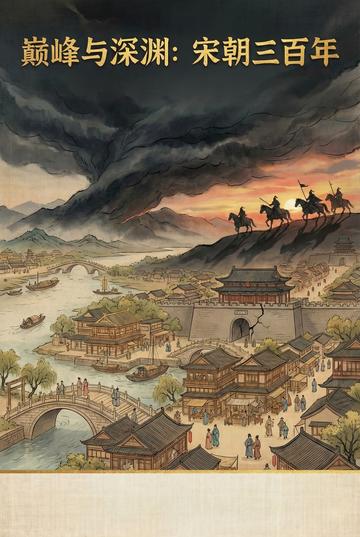
This is an ambitious and long history of Song Dynasty. This work refuses to pile up boring historical materials, but takes Huang Renyu's "big historical view" as its foundation and Qian Mu's "system analysis" as its weft. From the "underlying code" established by Zhao Kuangyin's night visit to the general public, to the macro-control and interest game in Wang Anshi's reform; from the severe pain of civilization in the Jingkang disaster, to the tragic and tragic Yashan naval battle. The work deeply draws on cutting-edge academic achievements such as "The Evolution of Song National History" to transform the game of power in the temple into workplace survival and class anxiety in the modern context.
This is not only a history of the rise and fall of emperors and generals, but also an in-depth experiment on the evolution of civilization and the dilemma of the system. In the noisy narrative, the author attempts to restore to readers a real Song Dynasty that has both the prosperity of Bianjing's dream and the sharpness of the northern country's sword. In the historical foreshadowing of the grass and the gray line, he explores the unfinished ideal of civilization on the "eve of the modern era".