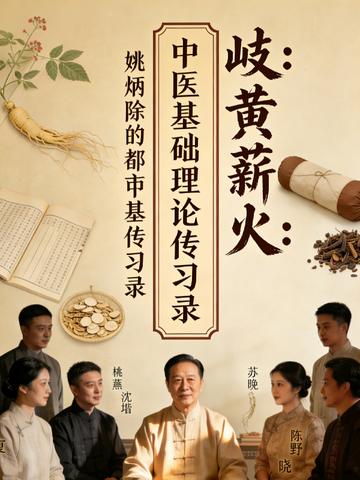
"Qihuang Xinhuo" is a Chinese medicine novel that can be read by ordinary people with zero basic knowledge.
The story takes place in Ningzhou, a new first-tier city. Yao Bingchu, a 52-year-old professor of traditional Chinese medicine, leads five apprentices with different personalities - theoretical doctor Lin Yan, surgeon Shen Ke, sensitive and delicate Su Wan, folk needleworker Chen Ye, and Internet operator Xia Xiao to reinterpret the ancient wisdom of traditional Chinese medicine using modern life scenes.
Why should ordinary people read it?
Don't speak slang, just speak human language. "Yin and Yang" refers to mobile phone battery and power, "Five Elements" refers to teamwork in the workplace, and "meridians" refer to the subway transportation network - each abstract concept becomes a familiar life scene that you can use immediately after reading.
Solve the discomfort of "can't find the fault". Insomnia is not about taking sleeping pills, but about "yang not entering yin", which can be improved by adjusting the light and soaking your feet and pressing three acupuncture points before going to bed; obesity is not laziness, but "spleen deficiency and dampness". Chewing three meals at a regular time is more effective than dieting; anxiety is not pretentious, but "liver stagnation turning into fire", a cup of rose tea with the word "sh" in the breath can relieve it.
A group of "people like you" will accompany you to grow. The process of apprentices from doubting to being convinced, from studying hard to applying it effectively is your learning path. Their confusions, mistakes, and breakthroughs make Chinese medicine approachable.
It can stand verification and is not metaphysics. Smart bracelets monitor sleep rhythms, infrared thermal imaging displays temperature changes in meridians, and AI body recognition and tongue analysis use modern scientific language to make ancient wisdom measurable and repeatable.
The book has nine volumes, ranging from yin and yang and the five elements to the internal organs and meridians, from the causes and pathogenesis to prevention and treatment, covering all the knowledge in "Basic Theory of Traditional Chinese Medicine"