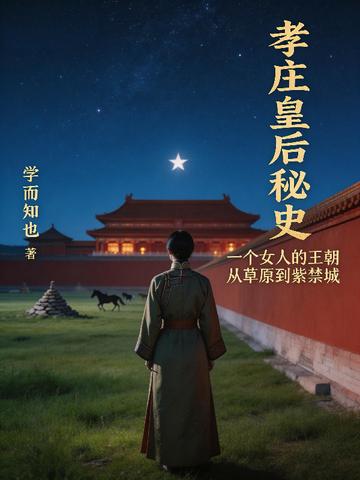
"The Secret History of Empress Xiaozhuang". She came from the grassland, but entered the deepest vortex of power in the Forbidden City.
At the age of thirteen, she married Shengjing and became Huang Taiji's concubine. Her husband is both a monarch and a mentor, and her sister is both a relative and an opponent. She learns to survive in the bloody harem, and first learns about the game of chess in the secret discussions in the study.
At the age of thirty-one, Huang Taiji died suddenly, leaving no edict. Holding her six-year-old son in her arms, she reached the "Broken Arrow Alliance" with the regent Dorgon - risking the lives of mother and child in exchange for her son's accession to the throne. From then on, as the Queen Mother, she endured the plot while being surrounded by wolves.
At the age of forty-nine, her son Shunzhi passed away. She once again held her eight-year-old grandson in her arms and walked to the dragon throne. This time, she was no longer just a guardian, but also a shaper - personally teaching Kangxi, clearing out powerful officials for him, and laying the foundation for a prosperous age.
At the age of seventy-five, before she died, she traced the map of the Qing Dynasty with her finger and passed away with a smile on her face. From Horqin Grassland to the Forbidden City, from Huang Taiji to Kangxi, she spanned three dynasties and experienced four emperors. She used wisdom instead of force to leave her own name in the history written by men.
She is Bumubutai, Concubine Zhuang, and Queen Xiaozhuangwen. A woman's life, an epic of dynasty's transformation.
Reader comments
Highly recommended!
"The Secret History of Empress Xiaozhuang" is unique in that it reconstructs the spiritual history of a female politician with "historian's bones + poet's brushstrokes".
Unlike most palace dramas that are full of power and intrigue, the author roots every plot in rigorous research, such as the "three-day contrast" between the death of the eighth son of the emperor and the birth of Fulin, the "de-sexing" treatment of Hong Chengchou's persuasion to surrender, and even Zhezhe's address to Concubine Zhuang strictly differentiates between occasions. However, within the framework of historical facts, the triple images of "grass seeds", "Haidongqing" and "Northern Star" are used throughout the book, giving Bumubutai's transformation from a grassland girl to a queen mother a poetic life scale.
This book also writes about the "temperature" and "folds" of history - the emperor's helplessness hidden in Huang Taiji's deep love for Hailanzhu, "I am here" when Aunt Sumala accompanied him for seventy years, and the trembling when Xiaozhuang turned her back when Shunzhi became a monk. These details allow historical figures to lose their facial makeup and become palpable "people".
This is a work that allows men to understand politics and women to understand destiny.
The horse taming scene at the beginning is heart-warming. Eleven-year-old Bumbutai faced the fierce horse that no one dared to approach. He walked over step by step without dodge. At that moment I was thinking, this girl is so brave. Later I learned that in her life, she had not only tamed horses, but also fate, people's hearts, and the entire world. From the grassland to the palace, she has been taming things stronger than herself.
The characters in this book are detailed and vivid.
Highly recommended! "The Secret History of Empress Xiaozhuang" is unique in that it reconstructs the spiritual history of a female politician with "historian's bones + poet's brushstrokes". Unlike most palace dramas that are full of power and intrigue, the author roots every plot in rigorous research, such as the "three-day contrast" between the death of the eighth son of the emperor and the birth of Fulin, the "de-sexing" treatment of Hong Chengchou's persuasion to surrender, and even Zhezhe's address to Concubine Zhuang strictly differentiates between occasions. However, within the framework of historical facts, the triple images of "grass seeds", "Haidongqing" and "Northern Star" are used throughout the book, giving Bumubutai's transformation from a grassland girl to a queen mother a poetic life scale. This book also writes about the "temperature" and "folds" of history - the emperor's helplessness hidden in Huang Taiji's deep love for Hailanzhu, "I am here" when Aunt Sumala accompanied him for seventy years, and the trembling when Xiaozhuang turned her back when Shunzhi became a monk. These details allow historical figures to lose their facial makeup and become palpable "people". This is a work that allows men to understand politics and women to understand destiny.
The horse taming scene at the beginning is heart-warming. Eleven-year-old Bumbutai faced the fierce horse that no one dared to approach. He walked over step by step without dodge. At that moment I was thinking, this girl is so brave. Later I learned that in her life, she had not only tamed horses, but also fate, people's hearts, and the entire world. From the grassland to the palace, she has been taming things stronger than herself.
The characters in this book are detailed and vivid.