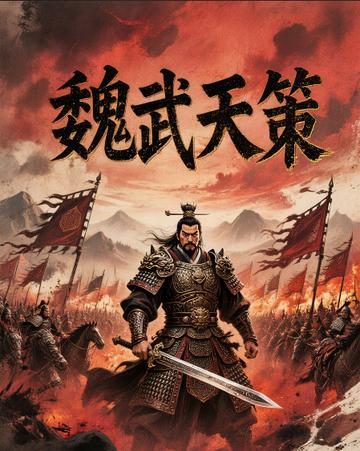
Chen Jia, a modern history researcher, was transported to the end of the Eastern Han Dynasty in an accident and became an unknown minor official under Cao Cao. At that time, on the eve of the Battle of Guandu, Yuan Shao's 100,000 troops were pressing down on the territory, and people in Cao's camp were panicked. Relying on his historical knowledge that transcended the times, he accurately predicted that Xu You would run at night and offer advice to attack Wuchao at night, changing the situation in one fell swoop and entering into the chess game of the Three Kingdoms' struggle for hegemony.
From the shocking plan of the Fire of Guandu to the east wind game on the Chibi River; from the thousands-mile march to the north to conquer Wuhuan, to the strategic contest of the westward march to Dingchuan, he used his wisdom to try to pave a road to unification for Cao Cao. But he soon discovered that history is not a picture that can be altered at will. Xun Yu's loyalty to the Han, Guo Jia's untimely death, Guan Yu's righteousness, Sima Yi's wolf-gu Zhixiang... The characters he had read countless times in history books stood vividly in front of him one by one, drinking and discussing with him, and also fighting with him.
What's even more troublesome is: when he knows everyone's fate, he can't change everyone's outcome; when he foresees Cao Wei's future, he finds that he is deeply involved in it.
From Cao Cao, Cao Pi to Sima Yi, from the end of the Eastern Han Dynasty to the founding of the Western Jin Dynasty, he witnessed the ups and downs of the Three Kingdoms and experienced the power game firsthand. During these one hundred and eighty years, is he a bystander of history or a chess player of fate?