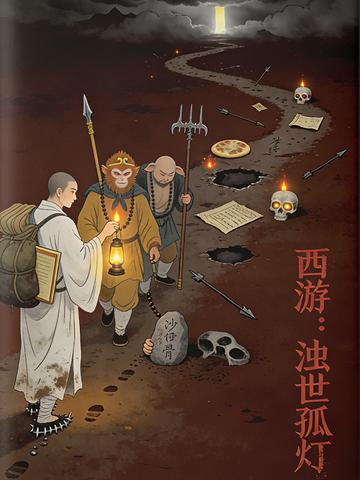
"Journey to the West: The Lone Lamp in Troubled Times" uses Xuanzang's journey to the west to obtain Buddhist scriptures as his bones, and the turbulent waves in the human world as his blood, to retell an earthly tragedy hidden under the cloak of gods and Buddhas.
The snow in Chang'an cannot cover the bones of the refugees, and the purple gold bowl cannot contain the blood and tears of the people. When Xuanzang took the letter of recommendation stamped with the familiar seal, the road he embarked on was never smooth - under the Five Elements Mountain, there were not only stone monkeys, but also the anger that had not cooled down for five hundred years; at the bottom of the quicksand river, there were not only skeletons, but also hundreds of thousands of crushed creatures; what the red candles in Gaolaozhuang saw was not marriage, but the separation of flesh and blood under the crushing power of power.
Along the way, demons are people wearing animal skins, and people are ghosts hiding fangs. The gods and Buddhas drank in the clouds, watching the officials pad the table legs with Buddhist scriptures, and exchange compassion for gold and silver; the heavenly soldiers waved their swords "to enforce the law for heaven" and flattened the rebel villages, but they bowed their heads before the Jade Emperor's glass cup. Xuanzang led three "demon disciples" to the west. The golden cudgel smashed illusions, the nine-tooth rake dug up the truth, and the demon-subduing staff picked up those names that had been erased from the history books.
What they seek is never the scriptures of the Western Heaven, but they want to ask "why" for the unjust souls who died in this world of cannibalism, and to hold a light for the living ants. When the golden bodies of gods and Buddhas begin to peel off, revealing the mud underneath, perhaps the real scripture is hidden in every ordinary person's struggle to "live".