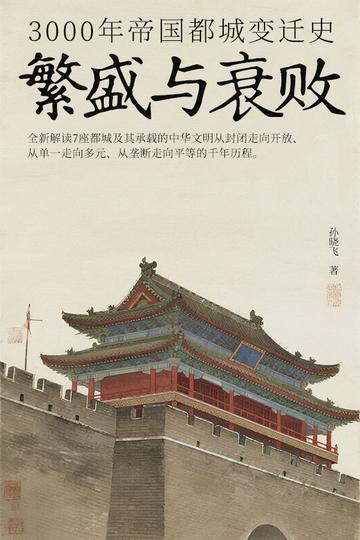
Space shapes history. From Xianyang, the city of the Son of Heaven, to Beijing, a modern international metropolis, this book breaks away from the old habit of interpreting history as a linear progression. Through the lens of spatial creation, it offers a fresh reading of seven capitals and the thousand-year journey of the Chinese civilization they embody, from isolation to openness, from uniformity to diversity, and from monopoly to equality.
Drawing on the theory of the production of space, developed by Henri Lefebvre, a foundational figure in urban sociology, Michel Foucault, a master of modern French thought, and others, this book escapes the constraints of linear historical description. From the perspective of spatial creation, it examines the development of seven ancient capitals across three thousand years: Xianyang, Xi’an, Luoyang, Kaifeng, Hangzhou, Nanjing, and Beijing. It traces their choices of location, urban layouts and administration, as well as their architecture and culture. It clearly shows how the capitals evolved spatially from isolation to openness, from uniformity to diversity, and from monopoly to equality. It also recounts the distinctive cultural character of each capital and the rise, decline, continuity, and transformation of the Chinese civilization they carried.