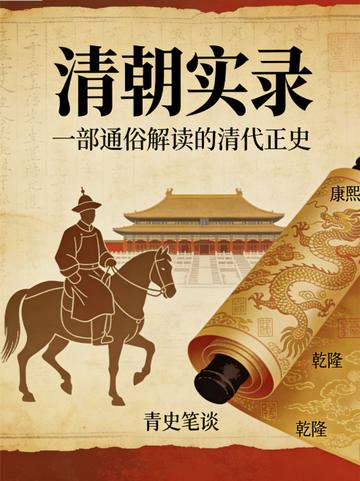
Taking the official history of the Qing Dynasty as the core skeleton, interspersed with folk unofficial history and palace secrets as flesh and blood, it focuses on the life stories, court games, and the rise and fall of the family and country of the twelve emperors of the Qing Dynasty (Nurhachi to Puyi), taking into account both seriousness and interest. No need to pile up obscure historical materials, no pretentious academic tone, just like chatting with friends, telling the past three hundred years of the Qing Dynasty - Nurhaci's passion for starting an army and starting a business, Huang Taiji's hidden secrets Ren's strategy to seize power includes the love-hate relationship of Emperor Shunzhi, the legend of Emperor Kangxi's talent and brilliance, the contrast of Emperor Yongzheng's diligence and suspicion, the glitz of Emperor Qianlong in his heyday, and the desolation of the late Qing emperors who were helpless.
The book avoids stereotyped narratives and restores the joys, sorrows, sorrows and joys of the emperors as "human beings". It also outlines the ups and downs of the powerful ministers, concubines, literati and ordinary people in the torrent of the times. It not only talks about the confrontation of power in the court and the heroes on the battlefield, but also talks about the filial piety of the parents in the palace and the fireworks in the folk market. It allows readers to understand the entire process of the Qing Dynasty from its rise, prosperity to its collapse in a relaxed reading, and see clearly the human nature and laws behind history. The total chapters are controlled at around 350, divided into units according to the imperial context. Each unit revolves around the core deeds of the corresponding emperor, interspersed with supplementary interpretations of related characters and events, taking into account both coherence and independence.