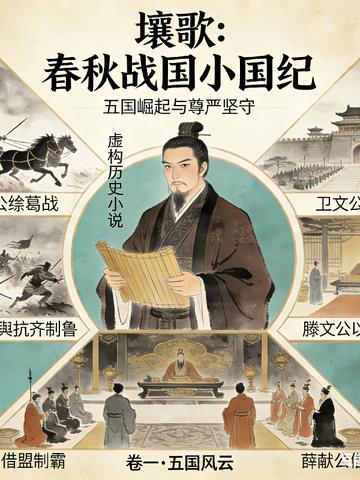
The core setting of the novel
1. Perspective carrier: Taking the historian "Mo Zhai" (not the founder of Mohism, a fictional character of the same name) who traveled around the world as a clue character, through his experiences, the rise of five representative small countries is connected in series, taking into account both historical reality and dramatic conflicts.
2. Selection of small countries: Select three types of small countries: "crack type", "revival type" and "cultural type" - Zheng Guo (an early hegemon, sandwiched between Jin and Chu), Wei Guo (reviving the country after the disaster of Di), Ju Guo (a powerful Dongyi country that resisted Qi and controlled Lu), Teng Guo (a ceremonial state that relied on etiquette to survive), and Xue Guo (a small Sishang country that borrowed alliances to control hegemony), covering the early, middle and late Spring and Autumn Period.
3. Core theme: The rise of small countries is not about "dominance" but "dignity in survival" - either relying on military strategies to break the situation, or relying on the unity of the people to restore the country, or relying on cultural etiquette to gain a foothold. Although most of them eventually belong to the big countries, the wisdom and struggle in the process constitute the "capillary history" of the Spring and Autumn Period and the Warring States Period.
Volume plot synopsis
Volume One: Zheng Feng·Yige Ming
- Core small country: Zheng (period of Zheng Zhuanggong)
- Difficulties in its rise: it was jealous of the Zhou royal family (King Huan of Zhou seized power from Zheng Bo), threatened by Jin to the west, infiltrated by Chu forces to the south, and had the aftermath of Gongshu Duan's rebellion internally.
- Key plot:
1. When Mo Zhai first arrived in Xinzheng, he witnessed Zheng Zhuanggong "dig the ground to meet his mother" to stabilize the internal affairs, and secretly formulated the strategy of "diplomating far away and attacking close" (uniting Qi and Lu to resist Zhou).
2. King Huan of Zhou led the three kingdoms of Chen, Cai, and Wei to attack Zheng. Duke Zhuang of Zheng used the "Fish and Li Formation" to defeat the coalition forces in Yuge. He shot and wounded the King of Zhou but "stopped his troops and did not pursue them." This not only established his authority but also avoided the reputation of "offending".