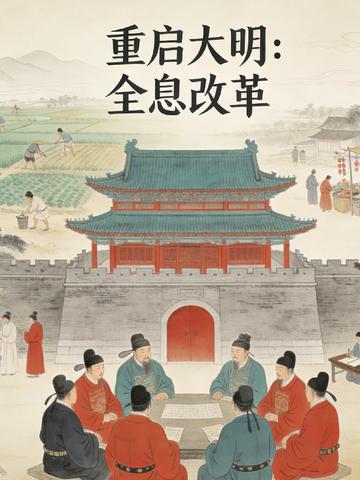
In March of the tenth year of Wanli (1582), Emperor Zhu Yijun suffered from a high fever for seven days, and his temperament changed drastically after he woke up. Pictures spanning time and space emerged in my mind - warnings from the tragedy of Meishan, as well as fragments of statecraft in later generations. He turned these "dream scenes" into inspiration for reform. On the basis of Zhang Juzheng's reforms, he took the ancestral law as the foundation and integrated modern governance concepts to comprehensively and systematically reshape the Ming Dynasty. Thirty-eight years later, Ming Dynasty was not only reborn, but also influenced the world with a new attitude, ushering in a global era belonging to the Eastern Empire.
The reform always follows the following: retaining the ancestral framework and deepening institutional functions; closed-loop checks and balances on power, efficient professional division of labor; rule of law as the cornerstone, with new and old honors running side by side; modern ideas entering the ancient system, and Chinese civilization opening a new chapter.
It is recommended that everyone taste it