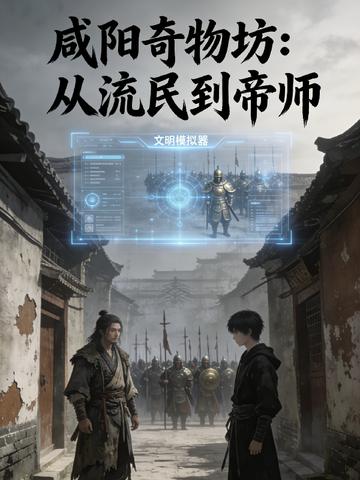
Programmer Lin Feng dies suddenly at his desk and wakes up in the body of a homeless wanderer on the streets of Xianyang.
He discovers that this world’s civilization index is only 0.7: it’s the Iron Age, the Hundred Schools of Thought prize abstract ideas over empirical proof, and even basic mathematics is woefully underdeveloped.
His only golden finger: a head full of modern knowledge and a ghostly [Civilization Simulator] floating in midair.
So he opens the first “Curiosities Workshop”: a hand-built magnetic calculator, a few logic puzzles, ten coins per try.
Business is slow, until a boy in black quietly waits in line for three days, solves a puzzle, then looks up and asks:
“Could this method... make a nation stronger?”
Lin Feng doesn’t know that the boy who calls himself “Zhao Zheng” is Ying Zheng.
He teaches the boy to use data to assess farmland, charts to expose corruption, and logic to solve dilemmas.
Alongside craftsmen abandoned by the Mohists, illiterate farmers, and women who have spent their whole lives by the stove, he builds the Heavenly Works Institute on the outskirts of Xianyang. From compost formulas to iron smelting in blast furnaces, from gear drives to data analysis, he takes one step at a time, stumbling along the way as he coaxes technological breakthroughs out of an age that should never have known them.
But when the Qin cavalry equips itself with standardized crossbows, and the first load of smokeless-coal pig iron from Shu arrives in Xianyang
The Civilization Simulator flashes a red warning:
Civilization leap accelerating. Risk of social fragmentation: 87%. Ideological conflict threshold exceeded.
And the silent boy from back then has become the First Emperor, whose might commands all under heaven.
Standing before a wall covered in data charts, he asks the question he has been contemplating for ten years:
“Sir, where does the Qin Empire’s potential end?”