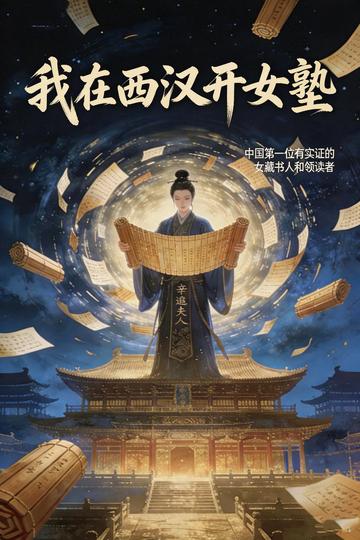
She was the wife of the Prime Minister of Changsha in the Western Han Dynasty and the first female bibliophile in China confirmed by archeology.
In the deep palace, no one knows the secret of her library - there is no war there, but there is a power sharper than a sword hidden there.
When the bloodstains of the Zhulu Rebellion were still fresh, and when Confucian scholars argued that "a woman's lack of talent is a virtue," she had quietly collected the scattered medical books, agricultural classics, and local chronicles into the cabinet. Each volume of annotations was a silent refutation of prejudice.
The nobles laughed at her for being obsessed with bamboo slips, but they didn't know that she used classics as warp and weft to weave an invisible web that maintained the family and influenced the government and the public. She did not set up a plaque for a girls' school, but she made the Hou Mansion the cultural hub of Changsha; she did not confront male power head-on, but she used silk books that are immortal for thousands of years to let history speak for itself.
It was not until two thousand years later that archaeologists opened her tomb and thousands of volumes of burial texts shocked the world that people finally understood how this most successful "guardian of culture" in history accomplished the toughest conquest in the gentlest way.
Reader comments
An excellent historical novel, the characters and stories are described very delicately and very realistically, making you suddenly fall into the drama. It is worth recommending to friends who like historical novels.
An excellent historical novel, the characters and stories are described very delicately and very realistically, making you suddenly fall into the drama. It is worth recommending to friends who like historical novels.
Great book! Worth reading! Highly recommended!