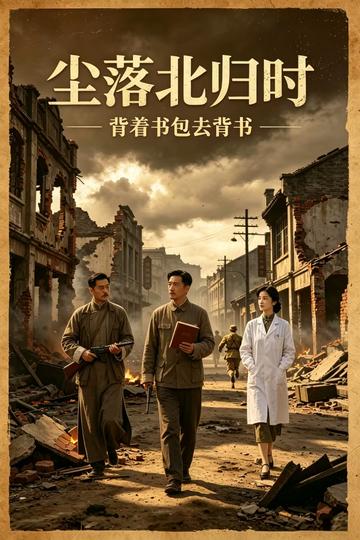
In the thirteenth year of the Republic of China, Yangzhou boy Chen Wangbei's parents died at the hands of a warlord who defeated the army. He fled to Shanghai alone and made a living as a coolie at Shiliupu Wharf. In the same year, Shen Qianchen, the son of a Shanghai industrialist, was dissatisfied with the marriage arranged by his family and ran away from home "to see the real Shanghai." Two 16-year-old boys with completely different backgrounds met at the pier and formed a lifelong friendship over a bowl of Yang Chun noodles.
The bloody massacre of the May 30th Massacre made them face the brutality of imperialism for the first time. Zhao Tiesheng, who attended the civilian night school, opened the door to revolution for them. The two worshiped each other in a ruined temple and swore "not to be born in the same year, the same month and the same day, but to die in the same year, the same month and the same day."
However, the tide of time rushed them down different paths. After the April 12 coup in 1927, Chen Wangbei went to Jinggangshan with the Nanchang Uprising troops and experienced five counter-campaigns and arduous long marches; Shen Qianchen stayed in the Kuomintang-controlled area, working under the iron heel of the Japanese invaders in his dual capacity as an industrialist and an intelligence officer.
When the all-out war of resistance broke out, the two met again in Wuhan. One fought bloody battles behind enemy lines, while the other fought through life and death on the hidden front. Su Wanqing's death from illness, Shen Botang's martyrdom for his country, and Alian's separation and reunion. The two brothers grew up amidst the hatred of the country and family, but they always cared about each other.
The Anti-Japanese War was victorious and the civil war resumed. On October 1, 1949, Chen Wangbei stood on the Tiananmen viewing platform, and Shen Qianchen stood next to the radio in Shanghai - they ushered in the birth of the same new China in different ways.