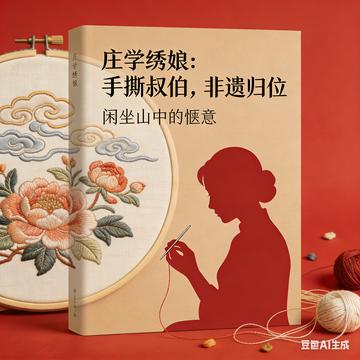
Su Jinyan, heir to a Su embroidery family, was driven out onto the streets after her uncles seized the embroidery workshop and stole its pattern books. Though she was reduced to earning her living as a street embroiderer, she guarded a heavily annotated copy of the Zhuangzi. Taking the equality of things as her guiding principle and fasting of the mind and sitting in forgetfulness as her method, she mastered the lost art of double-sided, three-color embroidery.
Others mocked her for carrying a book just to seem refined. She replied calmly, “You are not a fish, so how do you know what a fish enjoys?” When her uncles tore up her exhibition application in front of everyone, she coolly answered, “Water is the softest of things, yet it can overcome the hardest.”
When her second uncle, a fraudulent inheritor of intangible cultural heritage, flaunted counterfeits to deceive the public, she made a dazzling entrance with the Zhuangzi-inspired art at her fingertips. On the front, a hundred birds paid homage to the phoenix; on the reverse, the phoenix perched in a parasol tree. A third layer concealed the freedom of the Wandering Beyond. Each stitch carried the force of fate, and her embroidery unraveled every base and deceitful scheme.
As her skill advanced toward the Way and embroidery became one with the teachings of Zhuangzi, she turned the use of the useless into a way to break the deadlock. She brought her uncles down and reclaimed the workshop, stitching into every thread of Su embroidery a realm where heaven and earth, and I, were born together. In the end, she became a grandmaster of the art of embroidery.