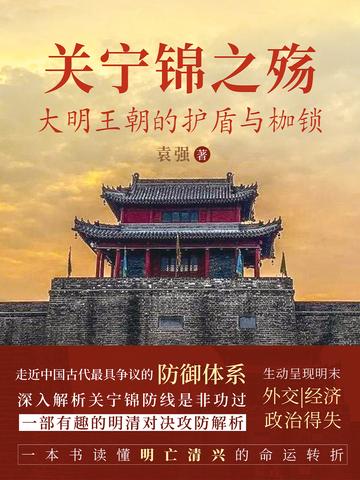
[Why did a line of defense across western Liaoning become the key code of the Ming and Qing dynasties?
[A tug-of-war that has lasted for decades, how many little-known plots and bloodshed are hidden?
In the battle of Saarhu, all the elites of the Ming Dynasty were lost, and Liaodong was in danger.
A Guan Ning Jin defense line rose from the ground in the hands of the emperor's master Sun Chengzong, but it became a pawn in the party struggle in the court, the Shura field of the fate of the side generals, and the shield and shackles of the Ming Dynasty.
This book focuses on the Guan-Ning-Jin Defense Line, the core of the Liaodong War in the late Ming Dynasty, and unlocks the deep code of the fall of the Ming Dynasty and the rise of the Qing Dynasty. Why did Xiong Tingbi's iron-blooded rule of Liao fail? Why couldn't the "steel defense line" built by Sun Chengzong with all his efforts prevent the collapse of the dynasty? Why did Yuan Chonghuan defeat Nurhachi in an isolated city, but ended up being executed by Lingchi?
From the shocking defeat of Saarhu to Ningjin's desperate counterattack, from the hidden arrows of the factional struggle in the court to the desperate battle behind enemy lines, there are too many unsolved mysteries hidden inside and outside the defense line: Why did Shanxi merchants risk annihilation to secretly communicate with Hou Jin? Why did Mao Wenlong's base behind enemy lines suddenly collapse? What kind of desperate situation is hidden behind Zu Dashou's three surrenders and three rebellions? Was Hong Chengchou's final defection an act of desperation or a premeditated move?
Through layers of archives, the book restores the predicament of the Ming Dynasty in which civil servants struggled for power, military generals were jealous of each other, and eunuchs disrupted the government; it revealed the true faces of Shanxi merchants, the Donglin Party, and the Eunuch Party behind the national crisis; it revealed the technical duel of the red cannon, and also revealed the corruption in officialdom in the late Ming Dynasty. Each suspense is intertwined to outline a tragic picture of Liaodong in the late Ming Dynasty, allowing readers to touch the temperature and depth of history in the tense plot and see clearly the inevitability and accident of the collapse of the Ming Dynasty.
Reader comments
This is a rare historical work that perfectly combines strategic depth with human subtlety. The author does not stay at the technical level of "why the defense line is strong", but digs into the institutional and human roots of "why the defense line eventually fails". I saw the traditional scholar-bureaucrat's responsibility of "everyone is responsible for the rise and fall of the world"; when I read that Xiong Tingbi was reported to Jiubian, and Yuan Chonghuan cried bitterly for his private sacrifice in the middle of the night, the sadness and indignation of "there is no talent left in the civil and military affairs, and the crime is a crime when the merits are great" passed through the back of the paper, which made people sad. The most successful thing about this book is that it turns vague names in history into "people" with warmth, struggle, and flaws. It not only tells the rise and fall of a line of defense, but also the process of how a huge empire lost its final ability to save itself due to internal strife. It still has profound implications for today.
The narrative structure is quite original. It uses the geographical and military concept of "defense line" as its bones, but it is filled with the full flesh and blood of politics, economy, technology, and personnel. From the tragic defeat of Saerhu to the painstaking construction of Sun Chengzong, to the glory and tragedy of Yuan Chonghuan, and finally ending with the collapse of the Songjin War, the context is clear and progressive. The book is interspersed with special discussions such as "Introduction of Red Cannon Technology", "Liaodong Farming Economy", "Shanxi Merchant Trade Network", etc., Like exquisite plug-ins, making the main story more three-dimensional and full. This writing method not only ensures the coherence of a general history, but also has the depth of special research, meeting the needs of readers at different levels. Whether you are a general reader who wants to understand the overall context, or a history buff who wants to delve into a certain detail, you can get satisfaction from it.
While reading, I was hit by that deep feeling of powerlessness several times. This sense of powerlessness comes from seeing the efforts and sacrifices of countless individuals (whether elites such as Xiong Tingbi and Sun Chengzong, or ordinary Liao soldiers and civilians) ultimately being swallowed up by a system that is becoming rigid and corrupt. The debates in the court are never-ending, but they are getting further and further away from the real life and death on the front line; strategies repeatedly swing between offense and defense, draining the country's power and people's hearts; loyal ministers and good generals either die on the battlefield, or die under the sword of their own people. This book is like a slow-moving tragedy. You know the ending, but you are still affected by every flash of hope and destruction along the way. It tells us that when an organization loses its ability to correct errors and common beliefs, even if it has a strong physical defense line, it will eventually fall apart. This is a lesson from history and a long-lasting warning bell.
This is not a relaxing book, but it is a book that makes people think deeply and leave endless aftertaste. When I close the last page, what comes to mind is not a specific battle or character, but a huge, gently tilting historical picture: on one side is the old empire that is trying its best to maintain order but is constantly at war with itself, on the other is the emerging force that is full of vitality but cruel and ruthless; in the middle are countless ordinary people who are caught up in their fate. The Guan Ning Jin Defense Line is like the most eye-catching crack in this picture, and it is also the best lens for observing that era. The book does not give simple historical answers, but raises profound questions: What is loyalty? What's the price? Which one is more important, the system or human nature? Thanks to the author for taking me through an ideological expedition with such a heavy writing style. This is perhaps the highest level of reading enjoyment a history book can bring.
This book made me re-understand the meaning of "line of defense". It is not only a pile of bricks and artillery, but also a synthesis of people's hearts, institutions and strategic resources. The author uses Guan Ning Jin's defense line as the axis to slowly unfold the intricate game of death in the late Ming Dynasty. What shocked me most was not the victory or defeat on the battlefield, but how those seemingly unrelated party disputes, suspicions and short-sightedness in the court were like termites, eating away inch by inch this "steel Great Wall" built with the efforts of the whole country. Sun Chengzong's loneliness, Xiong Tingbi's resentment, and Yuan Chonghuan's helplessness were all victims of system failure. Reading history to learn from the present, this book provides far more than a historical story, but also a profound warning about how organizations can collapse from within.
What touched me most about this book was the fate of those individuals who tried to turn the tide in the torrent of history, but were ultimately swallowed up by the torrent. They all have flaws, obsessions, and sometimes even appear to be "ignorant of the current affairs." However, the sense of responsibility of "knowing what cannot be done and doing it" shines with the tragic light of humanity against the backdrop of the doomsday world. After closing the book, these figures linger for a long time. History remembers successes and failures, and this book allows me to remember the traces of their struggles.
Looking at history means looking at the present. From history, we can see how a super project was screwed up.
If I had read this book in high school, my understanding of the history of the Ming and Qing dynasties would have been much deeper.
Seeing that Sun Chengzong came out of the mountain again in his later years, but was unable to save himself, I really felt the sadness of the hero in his twilight years.
I have seen the complexity of human nature. In the last days, it is difficult to define a person by simple loyalty and traitor.
The information density is very high, so you need to read it slowly and take some notes, but it is very rewarding and not a loss at all.
Taught me a lesson: never underestimate the speed and destructive power of corrosion within an organization.
Although the description of Emperor Chongzhen is short, the image of being impatient, suspicious, and helpless emerges vividly on the page.
It profoundly explains the saying of the Dream of Red Mansions: Killing from the outside cannot kill you for a while, and a centipede will die but will not freeze. Instead, it will attack and destroy itself from within, and it will be a total defeat.
The tragedy of Xiong Tingbi is unbearable. For such a capable minister, he ended up like that. It was unreasonable for the Ming Dynasty to survive.
Weeping for Xiong Tingbi, it is really chilling for a man who devoted himself to serving his country to end up with a bad job.
After reading this book, when I think about the Shanhaiguan and Ningyuan Ancient City I have visited, my feelings will be completely different.
While reading, I sighed countless times, if the Ming Dynasty could work together and if there were less party struggles, would history be rewritten?
The fate of a line of defense is written into the epitome of a dynasty, which is cleverly conceived.
The book's analysis of the party struggle in the Ming Dynasty is sharp and makes people understand that no matter how strong the defense line is, it cannot withstand the stabbing of one's own people behind the scenes.
The historical materials are solid and the narrative is smooth. It clearly explains the complicated history of Liaodong in the late Ming Dynasty. It is like watching a grand historical drama, with the fate of the characters tightly gripping your heart.
The narrative rhythm is well controlled and relaxed. It is not tiring to read, and it even has the pleasure of following a historical serial novel.
The diplomatic dilemma of the Ming Dynasty was written so thoroughly that it really turned friends into enemies.
The historical attitude of not being extreme and analyzing the choices of all parties based on the objective environment at the time is commendable.
This is not only a military history, but also a classic case study of organizational collapse.
The language is easy to understand and does not pretend to be profound, but the depth of thought is not bad at all. It can be enjoyed by both refined and popular people.
This "sad" is the outburst of multiple contradictions, playing the elegy of the Ming Dynasty. Although it is not an easy book to read, it is thought-provoking.
The author's writing style is very good, with the calmness of a historian and the warmth of literature, making the boring history vivid and touching.
The language is easy to understand and does not pretend to be profound, but the depth of thought is not bad at all. It can be enjoyed by both refined and popular people.
After reading it in one breath, the dead game of Ming Dynasty was brought to life by this book! The plot is clear, the characters are vivid, and it's enjoyable.
This is a rare historical work that perfectly combines strategic depth with human subtlety. The author does not stay at the technical level of "why the defense line is strong", but digs into the institutional and human roots of "why the defense line eventually fails". I saw the traditional scholar-bureaucrat's responsibility of "everyone is responsible for the rise and fall of the world"; when I read that Xiong Tingbi was reported to Jiubian, and Yuan Chonghuan cried bitterly for his private sacrifice in the middle of the night, the sadness and indignation of "there is no talent left in the civil and military affairs, and the crime is a crime when the merits are great" passed through the back of the paper, which made people sad. The most successful thing about this book is that it turns vague names in history into "people" with warmth, struggle, and flaws. It not only tells the rise and fall of a line of defense, but also the process of how a huge empire lost its final ability to save itself due to internal strife. It still has profound implications for today.
The narrative structure is quite original. It uses the geographical and military concept of "defense line" as its bones, but it is filled with the full flesh and blood of politics, economy, technology, and personnel. From the tragic defeat of Saerhu to the painstaking construction of Sun Chengzong, to the glory and tragedy of Yuan Chonghuan, and finally ending with the collapse of the Songjin War, the context is clear and progressive. The book is interspersed with special discussions such as "Introduction of Red Cannon Technology", "Liaodong Farming Economy", "Shanxi Merchant Trade Network", etc., Like exquisite plug-ins, making the main story more three-dimensional and full. This writing method not only ensures the coherence of a general history, but also has the depth of special research, meeting the needs of readers at different levels. Whether you are a general reader who wants to understand the overall context, or a history buff who wants to delve into a certain detail, you can get satisfaction from it.
While reading, I was hit by that deep feeling of powerlessness several times. This sense of powerlessness comes from seeing the efforts and sacrifices of countless individuals (whether elites such as Xiong Tingbi and Sun Chengzong, or ordinary Liao soldiers and civilians) ultimately being swallowed up by a system that is becoming rigid and corrupt. The debates in the court are never-ending, but they are getting further and further away from the real life and death on the front line; strategies repeatedly swing between offense and defense, draining the country's power and people's hearts; loyal ministers and good generals either die on the battlefield, or die under the sword of their own people. This book is like a slow-moving tragedy. You know the ending, but you are still affected by every flash of hope and destruction along the way. It tells us that when an organization loses its ability to correct errors and common beliefs, even if it has a strong physical defense line, it will eventually fall apart. This is a lesson from history and a long-lasting warning bell.
This is not a relaxing book, but it is a book that makes people think deeply and leave endless aftertaste. When I close the last page, what comes to mind is not a specific battle or character, but a huge, gently tilting historical picture: on one side is the old empire that is trying its best to maintain order but is constantly at war with itself, on the other is the emerging force that is full of vitality but cruel and ruthless; in the middle are countless ordinary people who are caught up in their fate. The Guan Ning Jin Defense Line is like the most eye-catching crack in this picture, and it is also the best lens for observing that era. The book does not give simple historical answers, but raises profound questions: What is loyalty? What's the price? Which one is more important, the system or human nature? Thanks to the author for taking me through an ideological expedition with such a heavy writing style. This is perhaps the highest level of reading enjoyment a history book can bring.
This book made me re-understand the meaning of "line of defense". It is not only a pile of bricks and artillery, but also a synthesis of people's hearts, institutions and strategic resources. The author uses Guan Ning Jin's defense line as the axis to slowly unfold the intricate game of death in the late Ming Dynasty. What shocked me most was not the victory or defeat on the battlefield, but how those seemingly unrelated party disputes, suspicions and short-sightedness in the court were like termites, eating away inch by inch this "steel Great Wall" built with the efforts of the whole country. Sun Chengzong's loneliness, Xiong Tingbi's resentment, and Yuan Chonghuan's helplessness were all victims of system failure. Reading history to learn from the present, this book provides far more than a historical story, but also a profound warning about how organizations can collapse from within.
What touched me most about this book was the fate of those individuals who tried to turn the tide in the torrent of history, but were ultimately swallowed up by the torrent. They all have flaws, obsessions, and sometimes even appear to be "ignorant of the current affairs." However, the sense of responsibility of "knowing what cannot be done and doing it" shines with the tragic light of humanity against the backdrop of the doomsday world. After closing the book, these figures linger for a long time. History remembers successes and failures, and this book allows me to remember the traces of their struggles.
Looking at history means looking at the present. From history, we can see how a super project was screwed up.
If I had read this book in high school, my understanding of the history of the Ming and Qing dynasties would have been much deeper.
Seeing that Sun Chengzong came out of the mountain again in his later years, but was unable to save himself, I really felt the sadness of the hero in his twilight years.
I have seen the complexity of human nature. In the last days, it is difficult to define a person by simple loyalty and traitor.
The information density is very high, so you need to read it slowly and take some notes, but it is very rewarding and not a loss at all.
Taught me a lesson: never underestimate the speed and destructive power of corrosion within an organization.
Although the description of Emperor Chongzhen is short, the image of being impatient, suspicious, and helpless emerges vividly on the page.
It profoundly explains the saying of the Dream of Red Mansions: Killing from the outside cannot kill you for a while, and a centipede will die but will not freeze. Instead, it will attack and destroy itself from within, and it will be a total defeat.
The tragedy of Xiong Tingbi is unbearable. For such a capable minister, he ended up like that. It was unreasonable for the Ming Dynasty to survive.
Weeping for Xiong Tingbi, it is really chilling for a man who devoted himself to serving his country to end up with a bad job.
After reading this book, when I think about the Shanhaiguan and Ningyuan Ancient City I have visited, my feelings will be completely different.
While reading, I sighed countless times, if the Ming Dynasty could work together and if there were less party struggles, would history be rewritten?
The fate of a line of defense is written into the epitome of a dynasty, which is cleverly conceived.
The book's analysis of the party struggle in the Ming Dynasty is sharp and makes people understand that no matter how strong the defense line is, it cannot withstand the stabbing of one's own people behind the scenes.
The historical materials are solid and the narrative is smooth. It clearly explains the complicated history of Liaodong in the late Ming Dynasty. It is like watching a grand historical drama, with the fate of the characters tightly gripping your heart.
The narrative rhythm is well controlled and relaxed. It is not tiring to read, and it even has the pleasure of following a historical serial novel.
The diplomatic dilemma of the Ming Dynasty was written so thoroughly that it really turned friends into enemies.
The historical attitude of not being extreme and analyzing the choices of all parties based on the objective environment at the time is commendable.
This is not only a military history, but also a classic case study of organizational collapse.
The language is easy to understand and does not pretend to be profound, but the depth of thought is not bad at all. It can be enjoyed by both refined and popular people.
This "sad" is the outburst of multiple contradictions, playing the elegy of the Ming Dynasty. Although it is not an easy book to read, it is thought-provoking.
The author's writing style is very good, with the calmness of a historian and the warmth of literature, making the boring history vivid and touching.
The language is easy to understand and does not pretend to be profound, but the depth of thought is not bad at all. It can be enjoyed by both refined and popular people.
After reading it in one breath, the dead game of Ming Dynasty was brought to life by this book! The plot is clear, the characters are vivid, and it's enjoyable.