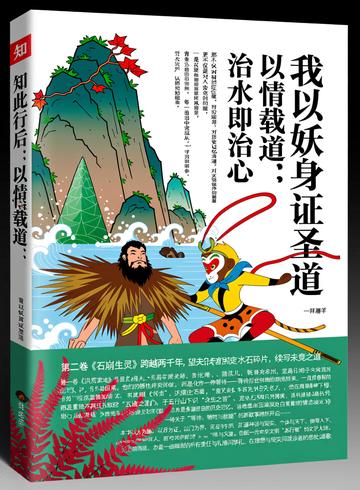
The whole book takes "Knowing comes first and then acting, carrying the road with emotion; to control water is to control the mind" as the core proposition, reconstructing the deep spiritual picture of Dayu's water control - it was not only the conquest of nature, but also the channeling of people's obsessions, the cleansing of historical memories, and the foundation of civilized order.
The first volume, "The Wilderness Splits the Earth," focuses on Dayu inheriting his father's fate, leaving his wife and children, and traveling to Kyushu, completing the cognitive revolution from "blocking" to "sparing" in blood, tears and wisdom. Sapphire cones, coir raincoats, red leaves, red ferns... Every token is a concrete form of emotion, and every inch of the river bed is engraved with the footprints of "walking and seeking knowledge". When the Tushan clan turned into Wangfu Stone and Dayu slept in Kuaiji Mountain, their sacrifice did not end, but turned into a kind of waiting - waiting for those who are destined in the future to pick up the fragments of Dingshui Stone and continue to write the unfinished road.
The second volume, "Stone Collapsing Creatures," spans two thousand years. The husband turned into stone and gave birth to a stone monkey, and the fixed water stone caused cause and effect. Sun Wukong is no longer a simple Monkey King, but a successor of Dayu's spirit. He realized the "Way of Water" under the Bodhi Seat, and realized the "suffering of all living beings" at the foot of the Five Elements Mountain. On his way westward, he no longer just sought scriptures, but repainted "Yu Gong" to ease people's hearts and purify distorted historical memories. When he sensed Bai Suzhen's emotional fluctuations deep in the West Lake, a new narrative about "waiting, sacrifice and redemption" quietly began...
This book uses water as the vein, stone as the witness, and door as the boundary to open up myth and reality, individual and world, emotion and avenue. It is not only a literary interpretation of the "knowledge and action" of Chinese civilization, but also a tragic ode dedicated to all those who are struggling between responsibilities and personal feelings, and trudging between ideals and reality.