In the autumn of the 28th year of Jiajing's reign, we were in prison in Hangzhou Prefecture.
Lu Jinglan, a female doctor of modern law, died suddenly after winning the international moot court championship. When she woke up, she was on death row in the Ming Dynasty. Charge: Stealing government silver, to be executed after three days.
The original owner was silenced because he witnessed the magistrate's murder. In prison, Lu Jinglan bribed the jailer with three pieces of silver, and caused a storm in the city with a letter, forcing the governor to hold a public trial.
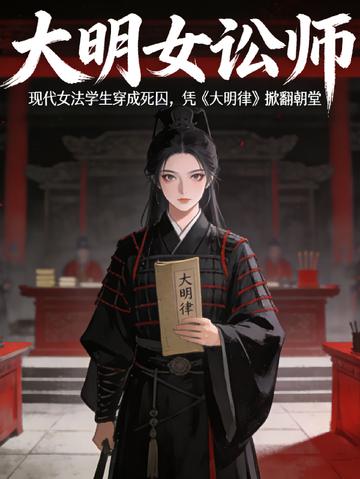
In the courtroom, her back was as straight as a pine tree, and her eyes were as cold as stars. Using the "Da Ming Law" as a blade, every word was like a knife, and the false evidence was full of loopholes, forcing the governor to be speechless. Among the crowd outside the hall, Shen Lu, a member of the Jinyiwei family, looked on with cold eyes - this woman was as fierce as wildfire, but also astonishingly smart.
After rescuing herself from prison, she became famous among the lower class in Hangzhou with her "three-money piece of paper". The embroiderer was robbed of her dowry, the farmers had their fields occupied, and the merchants were defrauded of their money... With a piece of complaint and three dollars to refinish the pen, she made "The Law of the Ming Dynasty" the sharpest knife in the hands of poor people.
However, there is an undercurrent beneath the calm. The eight mutilated corpses on the Qiantang River, the mysterious copper coins in the shipping department, the old case of his mother's "traveling with the Japanese" ten years ago, the mystery of the disappearance of 100,000 tribute silver three years ago... All clues point to the invisible "Sea Dragon King" on the southeast coast.
In order to find out the truth, she and Shen Lu pretended to be husband and wife and sneaked into the smuggling ship, but they accidentally stumbled into a shocking conspiracy to assassinate Emperor Jiajing. From Hangzhou to Ningbo, from Fuzhou to the capital, she wielded the sword of law as a woman and fought her way through the cracks between imperial power, prime minister power, maritime merchants, and Japanese pirates.
"Where the law is, there is justice."
These are the last words left to her by her mother, and they are also her only belief in this world of eating people.
Reader comments
"The law is bones, the human heart is flesh - this is the Ming Dynasty I want to see."
As a history buff, this book gave me so many surprises. The author is very attentive in researching the official system, laws, and social features of the Ming Dynasty. Every "Da Ming Law" cited by Lu Jinglan in court is well-documented, and the portrayal of characters such as Yan Song, Yan Shifan, Lu Bing, and Lu Fang is also consistent with historical facts.
What's even more rare is that the author does not simplify history or turn it into black and white. Emperor Jiajing knew what Lu Fang had done but acquiesced because he needed the money to keep the court running; Yan Song had been greedy all his life, but when he was old, he knelt in the Hall of Supreme Harmony and wrote his son's confession with his own hands; even a "villain" like Wang Shizhen had his own complexity and tragedy.
This is the kind of historical novel I want to read - not a joke, not a fiction, but a shocking flower that blooms in the cracks of real history.
What moved me most in the book were not the big cases, but the small cases - three coins of silver helped an embroiderer get back her dowry, and a piece of pleading helped farmers get their fields back. Lu Jinglan made me believe that there are really people in this world who are willing to fight against the darkness of the entire world for a penny of justice.
"Where the law is, there is justice." I will remember this sentence for the rest of my life.
"The law is bones, the human heart is flesh - this is the Ming Dynasty I want to see." As a history buff, this book gave me so many surprises. The author is very attentive in researching the official system, laws, and social features of the Ming Dynasty. Every "Da Ming Law" cited by Lu Jinglan in court is well-documented, and the portrayal of characters such as Yan Song, Yan Shifan, Lu Bing, and Lu Fang is also consistent with historical facts. What's even more rare is that the author does not simplify history or turn it into black and white. Emperor Jiajing knew what Lu Fang had done but acquiesced because he needed the money to keep the court running; Yan Song had been greedy all his life, but when he was old, he knelt in the Hall of Supreme Harmony and wrote his son's confession with his own hands; even a "villain" like Wang Shizhen had his own complexity and tragedy. This is the kind of historical novel I want to read - not a joke, not a fiction, but a shocking flower that blooms in the cracks of real history. What moved me most in the book were not the big cases, but the small cases - three coins of silver helped an embroiderer get back her dowry, and a piece of pleading helped farmers get their fields back. Lu Jinglan made me believe that there are really people in this world who are willing to fight against the darkness of the entire world for a penny of justice. "Where the law is, there is justice." I will remember this sentence for the rest of my life.