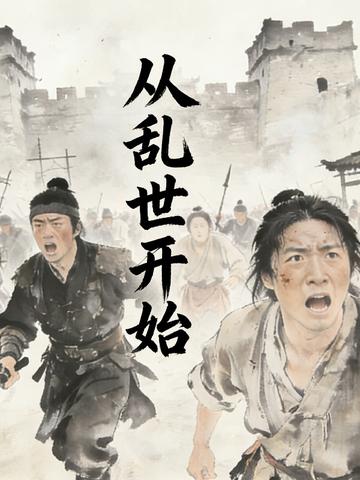
From the "Apocalypse Rebellion" to the "Peace Reign", Huayu Continent has gone through two hundred years of blood and integration. At first, the tenant Hong Tieshan raised his voice and established "Tianshun", but it quickly deteriorated in the palace in Luoyang. His "Eight Tigers" conquered and extorted money even more than the old Yong nobles. The world then fell apart, and twelve forces competed: Lu Xuanba's "Daliang" in Guanzhong, Shen Muzhi's "Nanchen" in the south of the Yangtze River, the "Golden Horde" in Tuobaye, Youzhou, Wang Yan's "Dacheng" in Sichuan, and the mighty powers of Hedong, Lingnan, Wuyue, Qi, Chu, and Fujian. The king's flags changed like horses.
On this chaotic stage, the core propositions are taking turns to be staged: the emerging "Huaixi Military Group" and the millennium gentry "Four Surnames of Wujun" are in fierce friction in the court; the cunning refugee commander Zhu Sankui repeatedly jumps between surrender and rebellion; the Wuhuan, Baidi and other tribes and the Han warlords merged with the Han warlords in the lands of Yanyun and Hexi with difficulty in bloody conflicts. All the melee was finally ended by Zhao Yuanqi, the hero of mixed blood between Hu and Han. He established "Dasheng" and initiated the "Yuanjia Rule", mixing up the Hu and Han Dynasties, and temporarily bringing peace to the world.
However, when the historian Liu Wenyuan wrote in the first year of Taiping that "land annexation resumed, and the luxury of the new rich flourished," the historical cycle that lasted for two hundred years - the erosion of power, the game of human nature, the integration and rebirth of civilizations - had already quietly planted the seeds of the next reincarnation in the folds of the new dynasty.