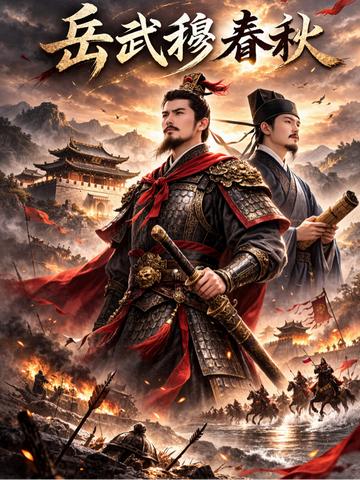
At the end of the Northern Song Dynasty, the world collapsed and mountains and rivers were broken. The Khitan was in decline, the Jurchens suddenly rose up, the cavalry went south, and the smoke of war swept across the Central Plains; during the Jingkang Incident, Bianliang was lost, the second emperor went north, and Yi Guan crossed south. From then on, the Song Dynasty settled on the left side of the Yangtze River. In this turbulent era of life and death, a warrior from a poor family rose from the countryside, joined the army, and stepped into the troubled times. He was Yue Fei. Yue Fei was not a god-ordained general, nor was he born noble, but he sharpened his skills step by step in exile and war. This book uses the real history of the early Southern Song Dynasty as the skeleton to reconstruct his complete life from a commoner boy to the commander-in-chief of the army. It writes about his difficult journey of building an army, training troops, the Northern Expedition, and resisting the Jin Dynasty, and also presents his loneliness and sobriety as he moved forward step by step in the cracks of power. On the battlefield, he forged his military spirit with strict military discipline and exchanged bloody battles for every inch of land. However, in the temple, he was repeatedly hampered, unable to advance and retreat, loyalty and reality constantly collided, and ideals and power clashed repeatedly. The novel not only unfolds the grand war scenes with swords and cavalry intertwined, but also deeply depicts the ups and downs of loyal men such as Zongze, Zhang Xian, Niu Gao, and Han Shizhong, as well as the intricate political games among powerful ministers, scholar-bureaucrats, and eunuchs, making the flames of war intertwined with people's hearts. This book does not portray Yue Fei as a flawless symbol, but restores a real character with edge, hesitation, blood and benevolence. He knew that the road ahead was dangerous, but always chose to face the tide of the times as a soldier; what he guarded was not only lost land and territory, but also the bottom line of a dynasty that refused to surrender. The name "Spring and Autumn" is not to commemorate the year, but to write down the choices and costs between rise and fall, success and failure.