In the spring of 1938, the New Fourth Army was ordered to assemble and reorganize in Yansi, Huizhou. A ragged but determined team faces a lack of equipment, identity and complex scrutiny under a united front.
The story unfolds from the perspective of Xu Tianlin, an old blacksmith from Yansi. His blacksmith shop became the melting pot of the times: he smelted the swords captured by the Japanese invaders and recast them to protect the country; he also beat the last piece of iron into a plowshare engraved with "flaming stars" and gave it to the ancient town, leaving behind the oath of "turning swords into plowshares". At the same time, the inspector Zhang Huaiyuan glimpsed the unyielding soul of this army under strict discipline from the cold numbers; Mr. Su Rusu used the mountains and rivers as a blade to draw a way out of guerrilla warfare; the female soldier Ling Fengzhi performed another kind of thrilling persistence between the radio waves and the stage.
This is not only a military reorganization, but also a spiritual tempering. In the night conversations at the ancestral hall, the forging of knives in the mountains, the delivery of crisis messages, and the bloody battle at Crow Ridge, individual destiny and the righteousness of the family and country violently collided, blended and reborn in the mountains and rivers of Huizhou. When the team finally marched eastward, they took away the tempered edge and left behind the immortal spark. A quenching epic where thunder is heard in silence begins.
Reader comments
"Silent Quenching" takes the ancient town of Yansi as a mirror and reflects the most touching civilian narrative in the epic of the Anti-Japanese War. With scalpel-like precision, the author dissolves the grand history between the fire of the blacksmith, the micro-carving marks, and the morning fog at the ferry, creating a group of civilian heroes who "listen to the thunder in a silent place". Cheng Wenhan's perseverance, Xu Laotie's silence, and A Liang's lurking jointly weave a historical brocade that has no heroic halo but shines with the brilliance of humanity. This is not only the memory of the Anti-Japanese War in southern Anhui, but also the spiritual inscription of all ordinary people who uphold morality in the cracks of history. The quenching is silent and the sparks are bright.
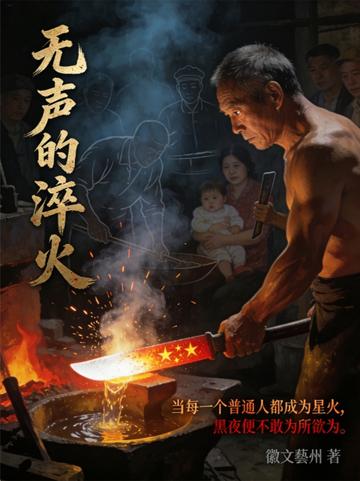
"Silent Quenching" takes the ancient town of Yansi as a mirror and reflects the most touching civilian narrative in the epic of the Anti-Japanese War. With scalpel-like precision, the author dissolves the grand history between the fire of the blacksmith, the micro-carving marks, and the morning fog at the ferry, creating a group of civilian heroes who "listen to the thunder in a silent place". Cheng Wenhan's perseverance, Xu Laotie's silence, and A Liang's lurking jointly weave a historical brocade that has no heroic halo but shines with the brilliance of humanity. This is not only the memory of the Anti-Japanese War in southern Anhui, but also the spiritual inscription of all ordinary people who uphold morality in the cracks of history. The quenching is silent and the sparks are bright.