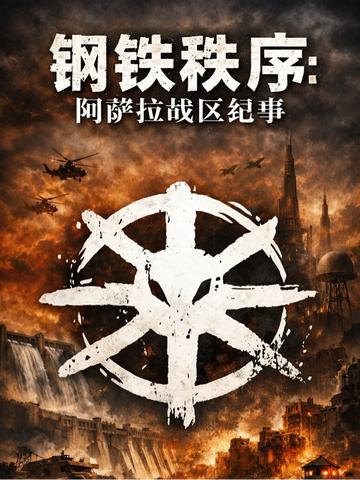
2035, Assala war zone. The gates of the Um River determine the breathing of a country: water, electricity, food, medicine, and even "who survives first" can be written into terms, calculated into formulas, and filmed as propaganda.
Dam Zero briefly revived Assala and allowed the Hafke Group to enter the land in the name of "legal cooperation." After the war broke out, the dam fell into the hands of the Asara Guards. Guard Captain Said has transformed from an avenger to a dam defender - he must use the least gunfire to restart the dam and revive the Oum River, but at the same time he cannot completely fall out with Hafk: the gate cannot be handed over, but the technology cannot be cut off; Hafk cannot enter the dam, but the influence is everywhere.
In Longbow Valley, another force is taking shape. Reis, who was born into a noble family, went from being a disgraced officer to a warlord: the Mandel Brick of the Diamond Queen Hotel, the keys and documents of the Halfkre Radar Station gave him a taste of "chips". Cracks within the Guard began to widen—Saïd demanded order, Reis demanded the price of victory.
When the war advances toward Baksh, the black thread of Hafk's hidden experiments and resources emerges; when the contradiction spreads to the space base, satellites and Skynet, spires and falls, the war is raised to a global level; and all accounts will eventually be settled in the Tidal Prison - between the Steel Order and the Riot Trial, everyone must answer: Does Asara need to be saved, or does she need to be ruled?
From Dam Zero to the Longbow Valley, from Bakshi to the space base, and then to the Tidal Prison, this is a war chronicle centered on the five war zones: the sound of gunfire is just the appearance, the real war is about who can hold the gate, the narrative, and the hearts of the people.
Reader comments
The huge and magnificent world view of the delta is under construction
"Iron Order: Chronicle of the Assala War Zone" is like a cold knife that cuts not the flesh and blood of the battlefield, but the "order" itself. The most ruthless part is not the gunfire, but the negotiation table: the crown, contract and algorithm sit on the same table, and whoever holds the gate can decide whether the lights will turn on or not, and who will live first. The author does not rely on stacking up to describe battles, but relies on details - evacuation lines, secret codes, registers, and supply ledgers. He writes with great weight the process of building a team from scattered soldiers into an organization. The differences between Reis and Said are also very interesting to read: one learns war as a business, and the other regards business as a crime. Both are reasonable and dangerous to each other. After reading, you will find that this is not a simple "villains and heroes", but a history of war zones about how power parasitizes people's hearts and systems.









The huge and magnificent world view of the delta is under construction "Iron Order: Chronicle of the Assala War Zone" is like a cold knife that cuts not the flesh and blood of the battlefield, but the "order" itself. The most ruthless part is not the gunfire, but the negotiation table: the crown, contract and algorithm sit on the same table, and whoever holds the gate can decide whether the lights will turn on or not, and who will live first. The author does not rely on stacking up to describe battles, but relies on details - evacuation lines, secret codes, registers, and supply ledgers. He writes with great weight the process of building a team from scattered soldiers into an organization. The differences between Reis and Said are also very interesting to read: one learns war as a business, and the other regards business as a crime. Both are reasonable and dangerous to each other. After reading, you will find that this is not a simple "villains and heroes", but a history of war zones about how power parasitizes people's hearts and systems.