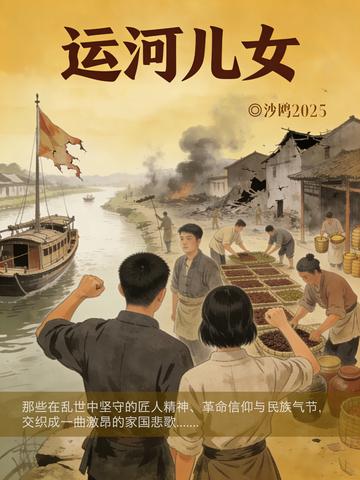
After the "September 18th Incident" in 1931, Jiang He, a young man from Bokou Village on the bank of the canal, followed his father's orders and went to Baoding Yuxiang Garden to learn how to make pickles. With his calmness and sincerity, he impressed the eccentric master Yushan, and learned the unique sauce-making skills. He innovated the craft with Sun Lanzhi, the daughter of the boss who had returned from Japan, and guarded the pickle garden together. They upheld the belief of "saving the country through industry" and secretly helped the anti-Japanese war.
Jiang and his brother Jiang Jia rose to prominence while escorting merchants to the south. They took charge of the canal fleet, adhered to their reputation of justice and trustworthiness, and risked their lives to protect the interests of merchants. Later, under the cover of the president of the "Japan-China Friendship Chamber of Commerce," they led the fleet to build a north-south anti-Japanese material transfer channel. The third brother Jiang Li joined the anti-Japanese war after witnessing the atrocities of the Japanese army. He grew from a passionate boy to a military agent, carrying out the task of eradicating traitors and adhering to the original intention of his family, country and emotions.
The Japanese army coveted the secret recipe of Yuxiangyuan and sent agents to sneak in in disguise and win over the apprentice Gu Jiusheng to cooperate inside and outside. Baoding's various forces were also undercurrent. Xue Mingli, who came from a military family, awakened and joined the revolution. She became the head of the underground party of the Communist Party of China, uniting all parties to resist Japan.
After the fall of Baoding, Jiang He and Sun Lanzhi maintained the production of the sauce garden despite difficulties, kept the secrets of sauce making, and built Yuxiang Garden into a secret transfer station to support the anti-Japanese war. Although the three brothers belonged to different camps, they formed a secret front because of national righteousness and worked together to resist the Japanese. In the decisive battle of Dawa, everyone joined forces to defeat the Japanese army's encirclement and suppression plan.
After the victory of the Anti-Japanese War, Jiang He and Sun Lanzhi continued the legacy of the soy sauce garden. Xue Mingli and Jiang Jia joined the War of Liberation, and Jiang Li was forced to go to Taiwan. For more than ten years, the people of Canal have fulfilled their original aspirations with perseverance and sacrifice, and composed a tragic song for their family and country that combines the spirit of craftsmanship, revolutionary beliefs and national integrity.
Reader comments
The writing is so beautiful, please click on it👍🏻👍🏻👍🏻👍🏻
To describe the history of that year in flesh and blood, the Chinese people must unite as one.
This work uses the Grand Canal as the background and writes a tragic hymn to resist Japan and Chiang Kai-shek. The story has a grand theme, twists and turns, the characters are full of flesh and blood, and the language is popular and fluent. It is a rare and good work!
Children of the Canal involves many characters, and the description of outstanding characters and general human nature is objective and credible. Complementary to the socio-historical background. It has the characteristics of traditional novels.

The writing is so beautiful, please click on it👍🏻👍🏻👍🏻👍🏻
To describe the history of that year in flesh and blood, the Chinese people must unite as one.
This work uses the Grand Canal as the background and writes a tragic hymn to resist Japan and Chiang Kai-shek. The story has a grand theme, twists and turns, the characters are full of flesh and blood, and the language is popular and fluent. It is a rare and good work!
Children of the Canal involves many characters, and the description of outstanding characters and general human nature is objective and credible. Complementary to the socio-historical background. It has the characteristics of traditional novels.