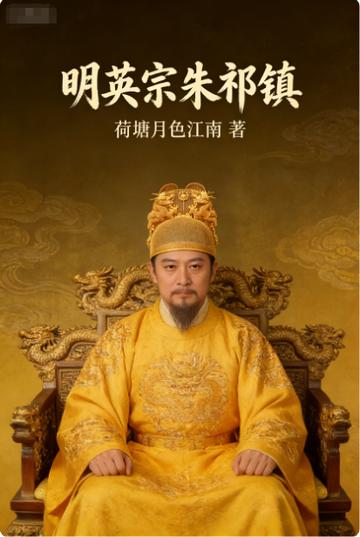
He was the most controversial emperor in the history of the Ming Dynasty. He ascended the throne twice in his life, half of his life was sober and half of his life was dim. He was once a high-spirited young emperor, but he was also a prisoner and trapped in the Nangong. He experienced ups and downs in the whirlpool of imperial power, and repeatedly struggled with the good and evil of human nature.
The whole book takes Zhu Qizhen's life as the main line, connecting the court games, border situations, and people's livelihood in the Zhengtong, Jingtai, and Tianshun dynasties, and focuses on his grievances and resentments with Yu Qian, Wang Zhen, Zhu Qiyu, Queen Qian, Li Xian, and others. Qiu not only restores the details of major historical events such as the Tumubao Incident, the Defense of the Capital, and the Gate Seizing Incident, but also analyzes the dilemma of checks and balances between imperial power and the civil servant group and the eunuch group, and also interprets the corruption and redemption of human nature by power.
Historical materials are the foundation, popular culture is the bones, and temperature is the soul. It does not deify loyal ministers, demonize sycophants, or make emperors look like emperors. It tells a history full of regrets and reflections in a tone that modern people can understand, allowing you to understand Zhu Qizhen's complicated life through laughter and tears, understand the code of the rise and fall of the mid-Ming Dynasty, and understand the multifaceted and impermanent nature of human nature under power.
Reader comments
I hope you can put this suggestion into action on the screen, and it will be successful. Thank you very much! ❤️(⋟⋞)
A well-organized and well-organized work, I really appreciate reading it every day [Like]
I hope you can put this suggestion into action on the screen, and it will be successful. Thank you very much! ❤️(⋟⋞)
A well-organized and well-organized work, I really appreciate reading it every day [Like]