


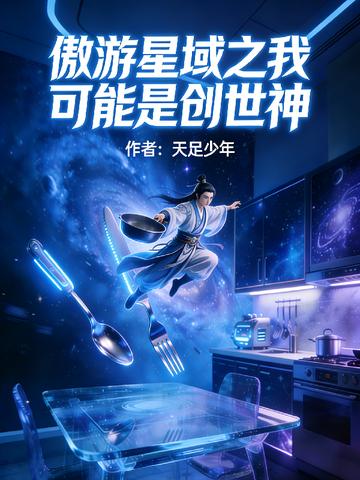
I May Be the God of Creation in Aoyouxingyu
傲游星域之我可能是创世神
- Status
- Completed
- Length
- 1.1M Words
- Genre
- Sci-Fi & Apocalypse
- Subgenre
- Unknown
- Updated
- 6mo ago
- Source
- Fanqie
Stats
209Chapters
1Reads
1Listens
53Reads · all time
Tags
Synopsis
More by this author
In booklists 1



Reader comments 1
Google Translate
"I May Be the God of Creation" is an interstellar light comedy with distinctive creativity and lovable style. It combines "kitchen creation artifacts", "gourmet cooking" and "cosmic adventure", and has taken a differentiated route among the common themes of interstellar, systems and artifacts in online articles. The following is a review from three dimensions: core highlights, potential optimization directions and overall potential for your reference: 1. Core highlights: the sense of contrast and the ingenuity of "removing routines" 1. The contrasting setting of "kitchen utensils = artifacts of creation", with built-in memory points and comedy genes Everyday kitchen utensils such as "pans" and "kitchen knives" are set as "creation artifacts" that can distort reality and harmonize the universe, completely breaking the stereotype that "artifacts must be swords, guns, swords and halberds/holy staffs". This "down-to-earth sense of holiness" is naturally suitable for comedy - for example, frying "antimatter popcorn" in a pan to destroy the engine, and using a space cutter to chop vegetables. It not only satisfies the feeling of "magical use of the artifact", but also dissolves seriousness through "the daily operations of a cook" and makes readers smile. This kind of "dimensionality-reducing percussive humor" (using the most ordinary tools to do the most outrageous things) is the core competitiveness of the work. 2. The cultural collision of "food + interstellar" expands the boundaries of imagination The interstellar background incorporates "misunderstandings of Earth's food culture" (such as alien civilization's bizarre interpretations of hot pot and stinky tofu) and "conceptual food creation" (gear stew, dimension jump pudding), making "food" not only a plot prop, but also a cultural symbol and emotional bond. For example, "Exposing the Illusion of the Gourmet Planet with Real Cooking" not only promotes adventure, but also coincides with the theme of "creating reality and fighting against illusion". It is more interesting than simply defeating monsters and upgrading. 3. The narrative rhythm of "light adventure + strong relationship" lowers the reading threshold The first 10 chapters focus on the duo of "Cook Ye Rui + Guardian Lin Na" and quickly establish bonds through small events such as "Garbage Station Secrets", "Star Chase", and "Food Contest". There is no lengthy world view, but a unit drama mode of "Crisis-Resolution-New Partner" is used to advance, which meets the "intensive and refreshing" needs of light novels/online novels. At the same time, the daily bickering (core comedy element 4) of "Serious Lin Na × Casual Ye Rui" provides stable emotional value, making the adventure not seem tiring. 4. The implementation of the theme "Creation and Reconciliation" to avoid emptiness It ends with "cooking to rebalance the universe" and defines the essence of the "creation artifact" as "the power of creation and reconciliation" rather than a tool of violence. This idea is very clever - using "cooking" as a metaphor for "repairing the cracks in the universe" not only echoes the identity of the "cook" at the beginning, but also provides a warm solution to the grand crisis of "Twilight of the Gods", which is more innovative than simply "fighting villains and saving the world". 2. Potential optimization directions: polishing the details from "interesting" to "profound" 1. Foreshadowing of world view: avoid "setting bombing" and use plot to penetrate naturally The current structure mentions settings such as the "Organization of the Guardians of Relics", "The Prophecy of Ragnarok", and the "Whereabouts of Multiple Artifacts". It is recommended that the game be gradually released through character dialogue, scene details, and crisis events, rather than centralized "explanation." For example: Lin Na's "past" (Chapter 8) can be shown through her flashbacks when she saw an artifact and her complaints about the internal conflicts of the organization, which is more immersive than directly "revealing the truth"; the threat of "Twilight of the Gods" can be embodied as a "lesson" for a galaxy to collapse due to the misuse of artifacts, allowing readers to intuitively feel the crisis. 2. Character arc: Strengthen "sense of growth" and "reasonable motivation" • Ye Rui: From "ordinary cook" to "possibly becoming the God of Creation", it is necessary to clarify the node of his psychological transformation - should he passively accept the mission, or actively identify with the value of "reconciling the universe with cooking"? For example, after the "first awakening" (Chapter 7), he can add his self-doubt about "whether he is worthy of the artifact", and then gain recognition by "using food to save the residents of the food planet trapped by hallucinations" (Chapter 6), so that the status of "Creator God" can be changed from "accident" to "choice". • Lin Na: The "seriousness" of the "Relic Guardian" must have reasonable motives (such as family mission, past trauma) to avoid becoming a "tool teammate". For example, it can be set that her failure to protect the artifact led to the sacrifice of her companions. Therefore, she is wary of the "artifact holder" and eager to find the "right person". This complements and conflicts with Ye Rui's "casualness", making the relationship more hierarchical from "forced cooperation" to "active trust". 3. Food details: from "conceptual gimmick" to "cultural carrier" The current "concept food" (antimatter popcorn, dimension jump pudding) focuses on "functionality", which can increase the details of the collision between the emotional memory of earth's diet and interstellar culture. For example: Ye Rui used the "braised pork recipe taught by his mother" to improve the "gravitational field braised pork rice", allowing alien diners to taste the "taste of home"; or a planet that only eats synthetic nutritional paste due to lack of resources, Ye Rui taught them to use local plants to make "fermented sour soup", which not only solves the problem of survival, but also conveys the concept of "food is culture", making "food" transcend "skills" and become a bridge connecting different civilizations. 4. Villain and conflict: clarify "motivation" and "logical closed loop" The motive of "hostile forces collecting artifacts to restart the universe" needs to be more specific - do they believe that the current universe is "rotten and needs to be reset", or are they misled by the "Twilight Prophecy of the Gods"? For example, it can be set that the leader of the villain was once an apprentice of the "Creation God", and went to extremes due to differences in ideas (thinking that "destruction is rebirth"), forming a philosophical opposition to Ye Rui's "reconciliation and creation", so that the final battle can be sublimated from a "power showdown" to a "debate of ideas", and using "a pot of 'reconciliation soup'" to resolve the conflict, which will have more lasting appeal than simply "smashing the villain to death with pudding". 3. Overall potential: "dark horse" potential in the light comedy track The differentiated positioning of this work is very precise: at a time when hard-core science fiction and dark online novels are popular, the combination of "Interstellar God of Cooking + Light Comedy" fills the market gap of "easy adventure into the universe". If you can maintain the contrasting cuteness of "artifacts in the kitchen", deepen the bond between characters and the details of food, and at the same time use "small events to reveal big themes" (such as resolving interstellar diplomatic crises with a meal), there is a chance that it will become the favorite of both "setting parties" and "easy readers". It is recommended to focus on polishing in the future: • Balance between the unit drama and the main plot: Each volume retains 3-4 "small food-themed copies" (such as "Taste War on the Spice Planet" and "Hot Pot Revival on the Frozen Planet"), interspersed with the collection of artifacts and conspiracy revelations in the main plot, to avoid drama [Top post][Bookshelf plus one][Laughing][Laughing][Laughing][Laughing][Laughing][Laughing]