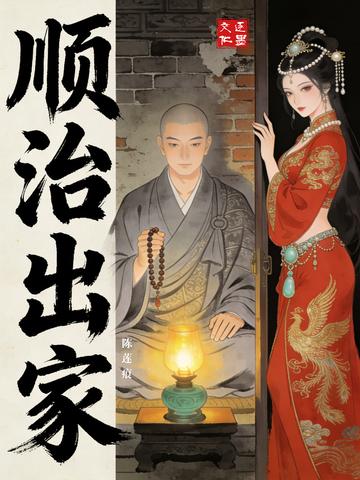
Shunzhi becoming a monk was the most controversial royal mystery in the early Qing Dynasty. Official historical records contradicted folklore, and the matter has been controversial for three hundred years. Emperor Shunzhi Emperor Fulin ascended the throne at the age of six. Although he was assisted by Empress Dowager Xiaozhuang and regent Dorgon, he always struggled with the constraints of imperial power and spiritual pursuits. He was especially obsessed with Buddhism and often summoned eminent monks to the palace to give lectures, which paved the way for subsequent rumors. The core turning point of the controversy was the death of his beloved Concubine Dong E. After entering the palace, Concubine Dong E was deeply favored. She was named the imperial concubine in four months after entering the palace. However, after the death of her beloved son, she fell ill and died at the age of twenty-four.
The death of Concubine Dong E completely devastated Shunzhi. He not only named her Empress Xiaoxian and personally wrote a 4,000-word memorial tribute, but also forced the whole country to mourn her in spite of the ancestral system. In grief, Shunzhi decided to escape into Buddhism and asked the eminent monk Mao Xisen to shave his hair. Fortunately, the Empress Dowager Xiaozhuang summoned Mao Xisen's master Yu Linxiu to the palace to dissuade him. Yulinxiu threatened to burn his disciples, so he forced Shunzhi to grow his hair and stay in the palace. According to official history records, in the first month of the eighteenth year of Shunzhi, he died of smallpox in Yangxin Hall. Before his death, he appointed Xuanye (Kangxi), who had suffered from smallpox, to succeed him. His body was cremated and buried in Xiaoling. The records of missionary Tang Ruowang and minister Wang Xi both confirm the theory of death from smallpox.
However, the theory of becoming a monk is prevalent among the people. It is said that Shunzhi pretended to die of illness, disguised himself as a monk and lived in seclusion in Qingliang Temple in Mount Wutai, with the Buddhist name "Xing Chi". Kangxi visited Mount Wutai six times in his life. Each time, he turned away his entourage and entered the temple alone. This was interpreted as a secret search for his father. There is also a legend that he accidentally met an old monk whose features resembled Shunzhi's and had a long talk behind closed doors and gave him gifts in tears. During the renovation of Wutai Mountain, a secret silk edict and an imperial sandalwood statue containing Shunzhi's private seal were discovered, adding support to the legend. In addition, Shunzhi's posthumous edict listed fourteen crimes, with a tone as grave as a confession, and was also questioned as a cover for "faking death to become a monk." Mainstream academic circles accept the theory of death due to smallpox, but the legend of monkhood has been circulated among the people for a long time because it carries the emperor's infatuation and yearning for freedom, and has become a historical mystery that spans hundreds of years.