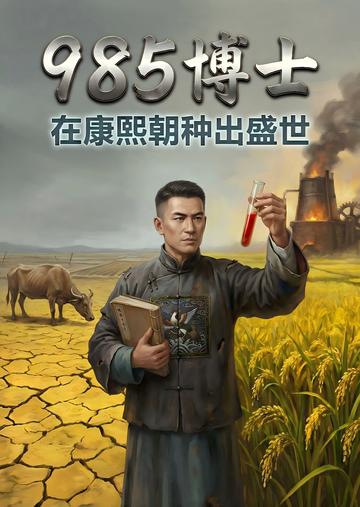
In 1662, the first year of the Kangxi reign, the Little Ice Age reached its bitterest point. The Qing Empire was sliding into the depths of the Malthusian trap: farmland lay barren, famine was everywhere, and a corrupt bureaucracy was draining the last vitality from this civilization like a parasite.
Su Xing, an agricultural science PhD from a top Chinese university, awoke in this age driven mad by hunger, with an immense agricultural database and modern logic in his mind.
Here, he doesn’t talk about morality. He talks about the second law of thermodynamics.
Starting with a pile of horse manure in Ningde, he uses anaerobic fermentation to gain political leverage and a phosphorus fertilizer revolution to produce miraculous yields. In the eyes of the gentry, he is a “Sage of Agriculture” who can turn stones into gold. In Kangxi’s eyes, he is the “heart” keeping the empire alive. In his own eyes, he is merely an experimenter “optimizing the System” in the Qing dynasty.
While the Neo-Confucian statesmen are still waxing lyrical about “preserving heavenly principles and extinguishing human desires,” Su Xing has already used “grain bonds” to lock down the southern financial system, colonized the islands of Nanyang with “seed patents,” and shattered the old order with the roar of the steam engine.
“Imperial power is an illusion. Only calories are eternal.” This is a forceful yet elegant civilizational transformation, directed by a PhD.